
Employee engagement describes employees’ emotional connection to their organisation. High employee engagement can create a competitive advantage and increase revenue. Organisations should therefore measure and improve employee engagement regularly – for example, with an online survey. Here you can learn how to measure employee engagement with a survey and find eight tips for increasing it. We have also provided a questionnaire template you can use to measure employee engagement.
Table of Contents
What is employee engagement and why is it important?
Employee engagement is an HR concept describing employees’ emotional connection to their organisation. It focuses on the extent to which employees are committed to achieving organisational goals. In other words, it concerns how strongly they identify emotionally with their employer and its mission. The concept is related to employee satisfaction, but it is not the same thing.
- Employee satisfaction is only the basis for employee engagement: satisfied employees are generally more likely to be engaged and perform at their best. Yet not every satisfied employee is automatically motivated to go the extra mile.
- Employee engagement goes beyond employees’ satisfaction with their workplace, tasks and managers. A sense of enthusiasm matters – not only for day-to-day work, but above all for the organisation’s goals and philosophy. Employees’ sense of belonging and the appreciation they receive from their employer are also crucial factors in increasing engagement.
Employee engagement can be defined as the degree of commitment employees have to their organisation and to achieving its goals. Their connection to the organisation and sense of obligation are intrinsically motivated.
Why is high employee engagement important for organisations? There is broad agreement that highly engaged employees are more productive and perform better. This is why employee engagement matters: productive employees contribute substantially to an organisation’s overall success and are less inclined to leave. Staff turnover falls. Organisations should therefore measure and improve employee engagement regularly.
Measuring employee engagement: examples
Employee engagement can be measured through surveys. A well-known example of measurement through a nationwide survey is the Gallup Q12® survey, which the market research institute Gallup has carried out regularly since 2001. Gallup Q12® forms the basis of Germany’s Engagement Index. According to Gallup, the survey measures employees’ emotional attachment and consists of 12 questions or statements. Respondents indicate their level of agreement with each statement. In line with the concept’s focus on employees’ connection with their organisation’s goals and values, one Q12® statement is: “The mission or purpose of my company makes me feel my job is important.” Find a summary of the Gallup Q12® questions on Gallup.com: Q12 Question Summary
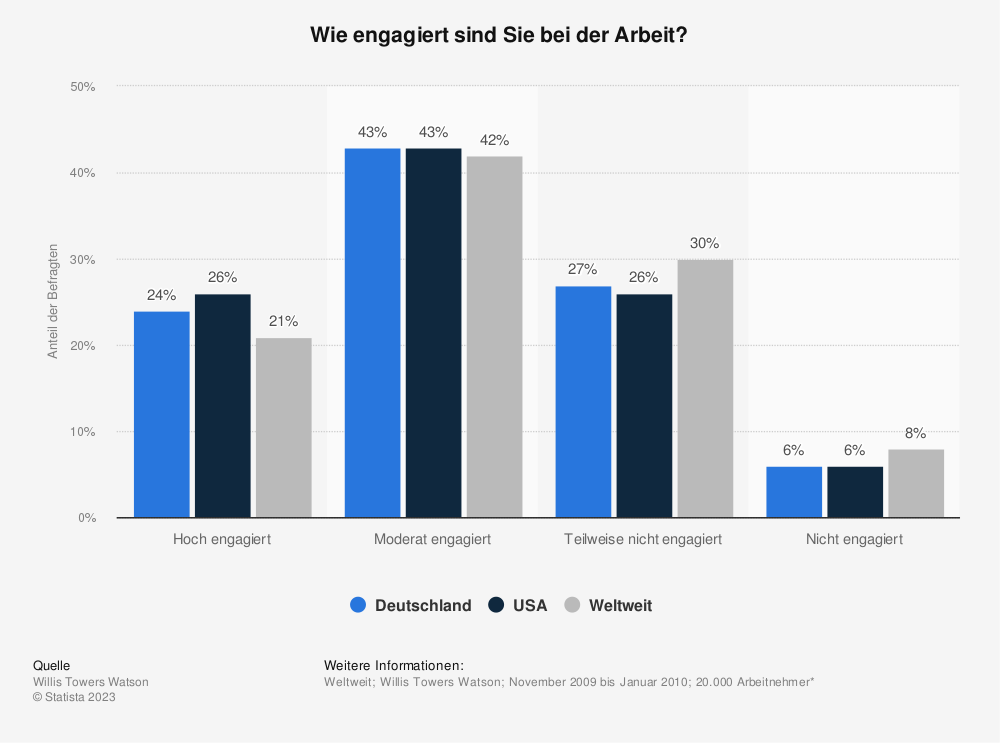
Another example of measuring employee engagement through surveys is the global research conducted by Willis Towers Watson (WTW). The consultancy conducts its Global Benefits Attitudes Survey every two years, including research into employer attractiveness and employee retention. One example is a global WTW study published in 2010 that also included employees in Germany: How engaged are you at work?
Measuring employee engagement with an online survey: questionnaire template
Employee engagement can easily be measured with an online survey. Compared with a paper-based survey, this saves time and, above all, costs. As with any employee survey, the anonymity of participants’ responses is crucial in an online employee-engagement survey. When employees are asked to share honest views about how connected they feel to their organisation, many consider anonymity important. With LamaPoll, an employee-engagement online survey can be conducted completely anonymously. Our Helpdesk provides guidance for survey creators: anonymous survey. The questionnaire can use a range of question types, including rating questions with a 5-point scale (1 = strongly disagree to 5 = strongly agree) and free-text fields for employees’ open feedback.
We provide a free employee-engagement survey template that you are welcome to use as a guide. Select “Use template” to copy it to your LamaPoll account and tailor it to your needs.
Our questionnaire template is based in part on Gallup Q12® questions.
Improving employee engagement: 8 tips
Organisations that improve employee engagement based on survey findings increase their chances of commercial success and competitive advantage. Here are eight tips to help. They cover transparent communication of organisational goals, managers’ behaviour, employee satisfaction in the workplace, development opportunities and a workplace culture shaped by recognition and appreciation.
- Communicate organisational goals clearly and transparently: Employee engagement includes identifying with and feeling enthusiastic about the organisation’s philosophy and goals. Senior management should formulate and communicate these clearly and transparently, so that current and prospective employees understand them.
- Embed sustainability in the organisation: Commitment to sustainability and sustainably run organisations is particularly important to younger generations. Organisations with a transparent sustainability strategy are more likely to help young talent feel connected to the sustainability issues that matter to the organisation, which can increase employee engagement. Read how to carry out a materiality assessment with LamaPoll as the basis for a sustainability strategy: conduct a materiality assessment.
- Raise awareness and train managers regularly: Engagement starts with managers. They communicate organisational goals to their teams and should act as role models. When managers approach their work with authentic commitment, it is easier for employees to work with strong motivation towards shared goals.
- Increase satisfaction in the workplace: Workplace satisfaction is the foundation of employee engagement. It is therefore important to improve employee satisfaction with suitable measures, such as team-building activities, fair pay and an ergonomically designed workplace.
- Recognise and value employees: When employees know their performance is recognised and they are valued as people, they are more willing to commit to the organisation. As a manager, show your employees that they contribute to the organisation’s success and matter to it. This helps create a sense of belonging.
- Identify and develop employees’ strengths: Employees are especially engaged when they can apply their strengths at work. Managers should get to know employees and their strengths, then support these strengths purposefully through competence management.
- Support employees’ professional development: A workplace culture of recognition and appreciation also includes employees’ professional development. Organisations can improve employee engagement by supporting professional development as part of their people-development work. Learn more: training-needs analysis – identify development needs online.
- Ask employees for feedback: To improve employee engagement, organisations should gather employee feedback regularly – through employee-engagement surveys, employee-satisfaction surveys, pulse checks or the Employee Net Promoter Score (eNPS). Asking employees for their opinion or assessment makes them feel involved and heard. This in turn strengthens their connection to the organisation.
Incidentally: Organisations that measure and, above all, improve employee engagement also strengthen their employer-branding strategy. Highly engaged employees make an employer brand more attractive and help attract new talent. Learn more: Employer branding: definition, examples and measures
What is LamaPoll?
LamaPoll is a survey tool for creating employee surveys and measuring employee satisfaction. You can use it to create, conduct and analyse all types of employee survey. Create your employee survey in just a few steps, apply your organisation’s corporate design and invite employees conveniently by email or via your intranet. You can quickly gain insights that help improve employee satisfaction. You can register for our survey tool free of charge and immediately conduct surveys for up to 50 employees with no obligation. If you need more responses to your online employee survey questionnaire, simply choose one of our monthly plans. You can also use our employee survey questionnaire templates and examples.