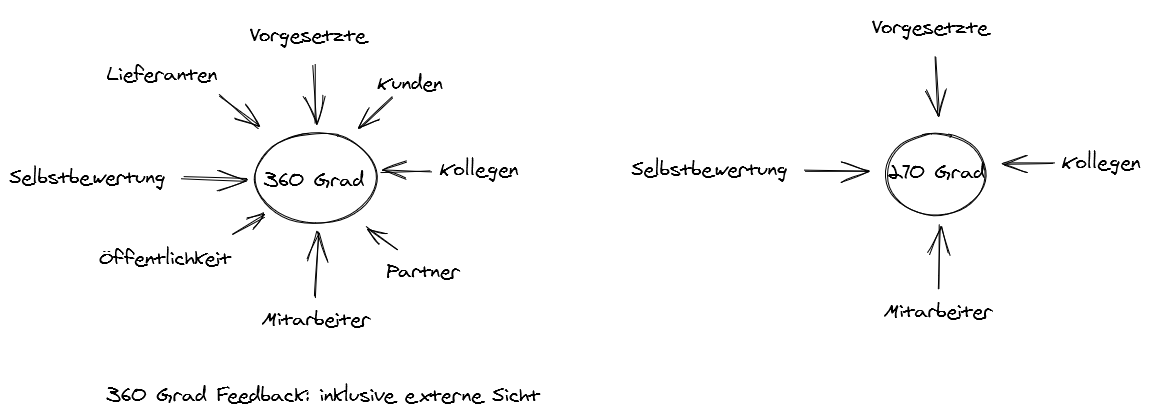
270-degree feedback is a method used by organisations to assess both aspiring and established managers. In most cases, when people refer to 360-degree feedback, they actually mean 270-degree feedback. This is mainly because these terms are neither precisely defined nor protected. The umbrella term is “multi-rater feedback”, also known as multi-source feedback—feedback provided by several assessors. Whether these perspectives form 270, 180 or 360 degrees when represented graphically is ultimately of secondary importance.
Table of Contents
What Is the Difference Between 270- and 360-Degree Feedback?
In 270-degree feedback, managers assess themselves and receive feedback from their own managers, direct reports and colleagues. This is the most common form of multi-rater feedback. However, it is suitable only for lower and middle management. Above a certain level in the hierarchy, there are too few colleagues—that is, assessors at the same level—to provide reliable results. For employees without management responsibility, 90-degree feedback is generally used: a self-assessment combined with an assessment by their manager.
Benefits of 270-Degree Feedback
Provided that there are enough colleagues to take part, 270-degree feedback offers advantages over the other forms:
270- versus 360-degree feedback: 360-degree feedback also includes external feedback providers, generally customers, suppliers or partners. This requires more effort because external parties need to participate, and their assessments may have only limited validity and objectivity. Genuine 360-degree feedback is most suitable when the manager has frequent and substantial contact with external parties.
270- versus 180- or 90-degree feedback: Feedback from colleagues at the same level and from direct reports is particularly meaningful—even more so than aptitude tests or other forms of assessment. If either perspective is missing, the result is greatly simplified. It may be preferable to replace traditional feedback from a manager with feedback from colleagues. Feedback from managers is highly subjective, not least because it usually comes from only one direct manager.
To support the manager’s sustainable development, 270-degree feedback should be repeated regularly. Many organisations repeat the process every one to three years.
Risks of 270-Degree Feedback
Particularly when a 270-degree survey affects variable remuneration, colleagues may collude and exchange favours instead of providing honest feedback. As explained elsewhere, multi-rater feedback should not be used for performance appraisal or similar purposes, but solely for staff development. In that context, honest feedback is less likely to conflict with personal interests.
The general benefits and risks of multi-rater feedback also apply: anonymity must be maintained, communication must be clear, and the process should not be conducted during a crisis, among other considerations.
Important Information and Tips for 270-Degree Feedback
- Transparency: Clearly communicate exactly what will happen to the results and who will be able to view them.
- Target group: Consider the consequences before inviting one or more managers. If only one manager is being assessed, how will this affect the others?
- Feedback providers: Many organisations select too small a sample from each group—colleagues, managers and direct reports. Others allow the manager being assessed to choose the feedback providers. In that case, the 270-degree feedback may be more appearance than substance.
- Questionnaire: Never adopt ready-made examples or templates for 270-degree feedback without adapting them to your organisation. Company values, culture and the position concerned determine which competencies need to be assessed.
- Questionnaire length: Unlike customer surveys, longer questionnaires can produce more meaningful and precise results in this context.
- Actions and follow-up: The same applies to other employee surveys: if no communicated or visible action follows, employees will lose confidence in the process.
- Feedback on the 270-degree feedback process: Regular evaluations should measure the tool’s impact, perception and efficiency.
USER FEEDBACK
WHAT B2B CUSTOMERS SAY ABOUT LAMAPOLL

Cooperation, clarification of content, questions of implementation, finding solutions and, above all, the immediate responses to enquiries, whether by email or by phone: at LamaPoll I have experienced an absolutely outstanding example of service-mindedness. The implementation is intuitive and simple. I would recommend LamaPoll to any of my colleagues.