
Online elections allow eligible voters to cast their vote digitally, from any location and within a defined period, via the internet or an intranet. Unlike voting in person at a polling station or by post, online elections do not require a physical ballot paper and are conducted digitally using software. Votes can be cast, for example, on a smartphone, tablet or desktop computer. The counting process is also electronic. Whether for club elections, general meetings, votes within organisations or votes for events and campaigns, an online election can make the entire process more efficient, transparent and secure.
Table of Contents
Conducting online elections: benefits of digital voting
Digital voting can improve flexibility and ease of use, increase participation, reduce costs and save time during preparation and implementation. Whether you are running a club election online or holding a vote to decide on an award, a virtual election enables you to reach a large number of eligible voters at once.
Eligible voters can also take part from any location and at any time within the voting period, whether from home, while travelling or elsewhere. Removing geographical and scheduling constraints can make participation easier. This can be particularly useful for clubs and organisations with large memberships spread across different locations.
In 2021, Bitkom e.V., Germany's digital industry association, published a study on e-democracy. It focused primarily on the public's willingness to participate politically online, including elections. According to the study, 61 per cent of respondents supported digital federal, local or state elections, while 37 per cent believed that online procedures could increase voter turnout.
The convenience of an online election can also make members more willing to take part in a vote or election. The basic voting process does not fundamentally differ from a paper ballot, but digital access can make participation easier.
One example of higher participation is the 2021 university election at Hof University. When the university held an online election for the first time, turnout was almost twice as high as in previous years (source: Hof University report on the 2021 elections).
Another benefit is that online elections can be designed to be accessible. With more than 615,000 registered clubs in Germany (see Figure 1) and many more individual members, inclusion and accessibility are important considerations. Make sure that all eligible voters have an equal opportunity to cast their vote. Making the process accessible can also help you reach a broader group of voters.
Find out more about accessibility with LamaPoll here: Create an accessible survey
Online elections can also reduce time and costs. Using a digital voting tool for the election and vote count can reduce the need for paper, staff and a physical venue.
Online elections can be made accessible and allow eligible voters to cast their vote conveniently from different locations. This can make participation easier and may have a positive effect on turnout.
- Lower use of resources and reduced costs
- Accessible online voting
- Potentially higher participation
- Greater flexibility and ease of use for voters
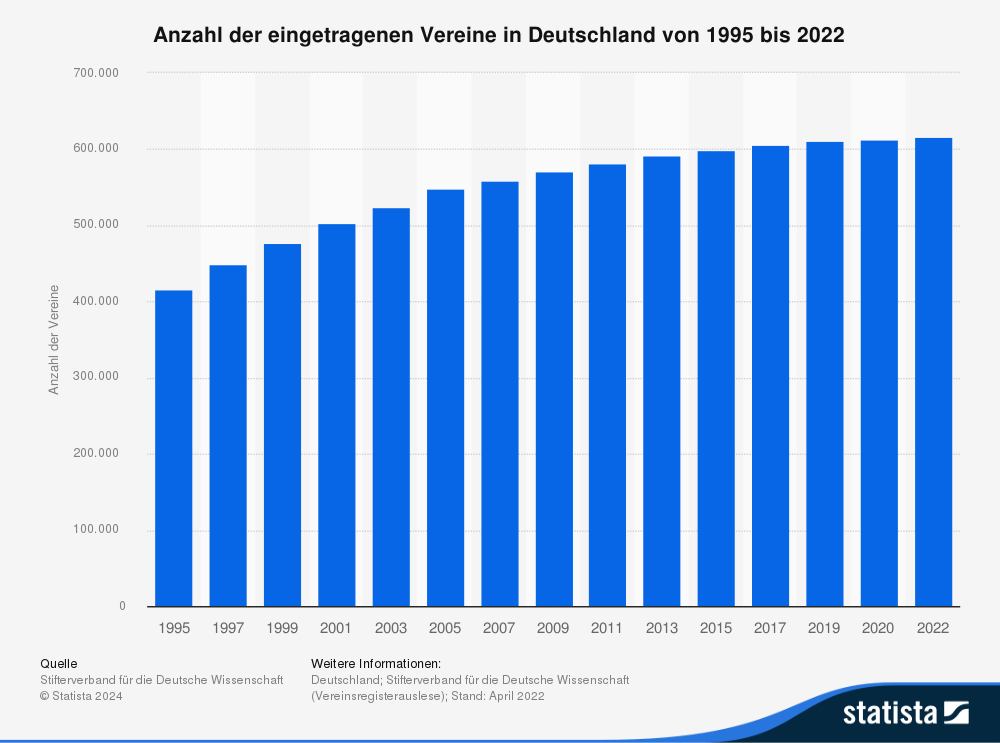
Fig. 1: The number of registered clubs in Germany has risen steadily since 1995 © Statista
Running online elections for clubs, foundations & other organisations: how it works
Following a change to German association law in February 2023, both hybrid and fully virtual general meetings are permitted without a prior amendment to the articles of association (Section 32 BGB). Holding an in-person meeting remains possible. A fully virtual general meeting may be convened if the members have previously resolved that future meetings may be held virtually. For a hybrid meeting, the convening body can provide for members to participate electronically. The move towards hybrid and virtual meetings, for example by video conference, chat or telephone conference, also makes flexible digital voting increasingly relevant for resolutions and elections.
Digital elections are generally conducted using election software or an online voting tool. Depending on the organisation, the election rules and the type of election, the following five electoral principles may be relevant to different degrees alongside the organisation's own rules:
- general
- free
- equal
- direct
- secret
These principles (Article 38(1) of the German Basic Law) apply primarily to political elections, but they can also provide guidance for non-political elections. The online election process should also be understandable and transparent for voters, from preparation and voting through to the counting of votes. The ability to scrutinise the process, together with the principles of free and secret voting, is particularly important for online elections in order to reduce the risk of manipulation and enable appropriate checks.
However, any secret election or vote, whether digital, in person or by post, carries some risk of manipulation. Before planning the election, determine which risks are acceptable and which requirements are essential for your specific vote.
What applies to board elections in German registered associations? Whether and under what conditions electronic voting is permitted in a board election depends on the applicable law as well as the association's articles and, where applicable, its election rules. Section 32 BGB permits hybrid and virtual general meetings under the conditions set out there. If an amendment to the articles is required for the specific election, it only takes effect for a registered association once it has been entered in the register of associations (Section 71 BGB).
Measures to protect online elections against manipulation
Various technical measures can be used to support secret voting so that a person's vote cannot be inspected or traced by unauthorised parties. Which measures are appropriate depends primarily on the level of risk you are prepared to accept and the conditions you can put in place. One option is end-to-end verifiability, which can be divided into three stages.
First, election software verifies whether a submitted ballot comes from an eligible voter, for example by using a signature or key. The second stage is individual verification, which allows voters to check that their vote was transmitted as intended, for example by using a QR code. The final stage is universal verification, which allows those responsible for the election to check whether the stages of the election were carried out correctly and whether votes were counted accordingly. The German Federal Office for Information Security (BSI) commissioned a study on end-to-end verifiability methods for online voting. You can find the study here: End-to-End Verifiable Online Voting
The principle of free voting can also be more difficult to safeguard in an online election than in a conventional polling station. As with postal voting, it cannot be completely ruled out that a voter may be influenced while casting their vote. Some election tools therefore support re-voting.
How does re-voting work? A voter can change a previously submitted vote because only the last vote cast is counted. The idea is that someone who was pressured or influenced when first voting can later cast another vote and thereby invalidate the coerced vote.
Other tools, including POLYAS and LamaPoll, use a different approach and allow voters to cast only one vote in order to prevent multiple voting. Depending on the provider, individual access keys, voter IDs, passwords or other methods can be used to verify eligibility, prevent multiple submissions and make a submitted ballot binding. This is broadly comparable to the process at a German polling station, where eligibility is checked against the electoral register before a single binding ballot is cast.
To assess whether the software for your election meets current security requirements, consult the BSI Protection Profile for online voting products under the Common Criteria, published in 2024 (BSI-CC-PP-0121): Protection Profile for E-Voting Systems
The protection profile defines security requirements for online voting products, including cryptographic processes such as homomorphic encryption, which enables calculations to be performed on encrypted data without decrypting it first.
If you are planning an online election with a high protection requirement under the BSI IT-Grundschutz methodology, the security requirements should be guided by BSI Protection Profile BSI-CC-PP-0121 and Technical Guideline TR-03169.
Use practical questionnaire templates
Run online elections and votes with LamaPoll
Use LamaPoll to create, run and analyse live votes, online votes and online elections. To prevent people from voting more than once, you can create a closed survey and use individual access keys. With an appropriately anonymous setup and distribution of the access keys, this can also support anonymous voting. You generate the individual access keys directly in LamaPoll.

Fig.: Voter notification, voting, secure data processing and analysis: all stages of an online election are handled digitally.
You can also send these access keys to voters using LamaPoll's mailing system. For an anonymous election, you can download the generated access keys and have the election organisers distribute them randomly to voters. Authentication, meaning the unique identification and verification of an eligible voter, is technically difficult to implement. A closed survey with access keys can prevent people from voting more than once and restrict access to people who have a valid key. In an anonymous setup, preserving anonymity also depends on how the access keys are generated, distributed and managed.
LamaPoll provides extensive safeguards for data security and data protection. LamaPoll survey software is ISO 27001 certified, and data is processed in Germany without interfaces to other providers or cloud services. Find out more about how your data is protected: Privacy & security
You can also use our free questionnaire template for a sample board election. You can preview the template or copy it directly into your LamaPoll account.
Are you planning an award or prize selection process? LamaPoll allows you to manage the application process for potential candidates using an online survey and then run an online vote to determine the winner. Our Helpdesk explains step by step how to create an online vote: Live voting and online voting
For non-anonymous votes, elections and polls, embedding the vote directly on a website via iframe can help you reach a wider audience. Find information about integration here: Embed a survey on your own website
Mobile usability is equally important. Make sure that your votes and elections are easy to read and use on smartphones and tablets. LamaPoll creates responsive online surveys automatically. Use the preview mode in the tool to check in advance how your content will appear on mobile devices.
Looking for a tool to run a small vote or online election for free? LamaPoll's Free plan also allows you to run a closed survey with individual access keys. This can be suitable for small clubs with fewer than 50 members or for small-scale votes. LamaPoll is also recommended by fairlinked.org for this use case (source: Mit den richtigen Tools online abstimmen).
You only need an email address and password to get started.
FAQs about online elections
In an online election, both voting and counting are carried out using election software. Eligible voters cast their votes digitally using personal devices such as smartphones, laptops or tablets, or via an intranet. Voting takes place remotely over a predefined period, giving eligible voters greater flexibility and ease of use.
Online elections can be used in many different contexts, particularly for non-political voting. Clubs, associations, churches and foundations can benefit from digital elections when meeting in person would require members to travel long distances. University elections and votes for awards can also be conducted using election software.
Digital elections and votes can make participation much easier, save organisers and voters time and money, and potentially reach a larger group of participants.
Whether and under what conditions electronic elections are permitted for clubs, foundations or universities depends on the applicable law as well as the organisation's articles and election rules. For German registered associations, Section 32 of the German Civil Code (BGB) permits hybrid and virtual general meetings under the conditions set out there. Before planning an online election, check which requirements apply to your organisation and the specific election. If an amendment to the articles is required, it only takes effect for a registered association once it has been entered in the register of associations.
The technical requirements for taking part in an online election are generally straightforward. Nevertheless, they should be communicated clearly in advance so that all eligible voters can participate without unnecessary problems. In most cases, voters need their own device and an internet connection. Outdated browsers may cause difficulties, so it is advisable to state clearly that an up-to-date operating system and browser are required.
Also consider the following questions: Is an additional app required alongside a device and internet access? Are personal access keys, QR codes or signatures used? Which browsers can be used? Is the voting process accessible? How long does it take to cast a vote?
The conditions should be clear to everyone involved, both for the voting process itself and for the technical requirements. A pre-test or test election carried out by the organisers is also advisable to help ensure that the process works smoothly.
Election software is generally designed so that voters can use their own devices, such as a smartphone, tablet or computer, to cast their vote. A workplace computer connected to an intranet may also be suitable. The organisers should clearly communicate the specific technical requirements for successful participation in the election documents in advance.
With LamaPoll, you can also run small online elections and votes using the Free plan. The Free plan is intended for elections with fewer than 50 eligible voters. From 50 participants onwards, a paid plan is required.
First decide whether you want to run an anonymous or non-anonymous election. For an anonymous setup, create a closed survey and activate the relevant access protection in the questionnaire settings.
You can then generate individual access keys. This allows you to prevent people from voting more than once. For an anonymous election, preserving anonymity also depends on how the access keys are generated, distributed and managed.
There are two ways to distribute the access keys to voters:
- Send the access keys generated in LamaPoll directly using the LamaPoll mailing system.
- Download the access keys and distribute them yourself by email using a random allocation process.
It is not possible afterwards to determine whether an access key was used by the intended person. LamaPoll does not authenticate the identity of the voter when the vote is cast.
The risk of attempts to manipulate elections or votes can never be ruled out completely. For an online election, it is therefore important to choose secure software and first determine the level of protection required. If the election has a high protection requirement under the BSI IT-Grundschutz methodology, two frameworks can be used as guidance:
- Technical Guideline TR-03169
- BSI Protection Profile BSI-CC-PP-0121
Even if your digital election does not have a high protection requirement, security should still be considered carefully. Review the safeguards used by the chosen tool to reduce the risk of manipulation. Data protection is also an important part of planning. LamaPoll supports GDPR-compliant data processing and is certified to ISO 27001.
Political elections such as German federal elections are currently not conducted online. Voters can cast their vote in person at a polling station or use postal voting.
Concerns around manipulation, cyberattacks and the technical implementation of the constitutional electoral principles are among the reasons online voting is not currently used for German federal elections. Under Article 38(1) of the German Basic Law, federal elections must be general, direct, free, equal and secret. Whether online voting will be introduced for political elections in Germany in the future remains open. Estonia, by comparison, has offered internet voting in national elections since 2005.

As an umbrella association in Germany, we hold an annual public vote. For the 2023 vote, we chose LamaPoll as our provider. As a non-profit organisation, we were able to purchase a discounted licence. Because we could not estimate participation in the first year, LamaPoll was flexible and found a fair solution even when participation was unexpectedly high. Contact with the support and sales team was pleasant and competent, and LamaPoll also accommodated our special requests. Creating the online vote was easy and met our technical requirements without any problems. The vote itself ran smoothly and without technical issues. We received positive feedback from participants and had a dropout rate of only 1.2%. Another argument was the server location in Germany and GDPR compliance. We are very satisfied with the solution and will use LamaPoll again.