360-degree feedback is a feedback method used by organisations to assess specialists and managers. We usually associate “360 degrees” with a broad view in every direction. With 360-degree feedback, the perspective is reversed: one person is at the centre, assesses themselves and is also assessed from all sides. Employees assessed using 360-degree feedback usually work in middle management, hold a leadership position or aspire to one. 360-degree feedback may be one of the most valuable staff development tools. Here, you will learn why and what matters when using it.
Table of Contents
Multi-Rater Feedback: 360-, 270-, 180- and 90-Degree Feedback
360-degree feedback is also known as multi-rater feedback. Put simply, one person receives feedback on their skills and qualifications from several other people or roles.
Important: A distinctive feature of 360-degree feedback is that the person concerned—usually a manager—also assesses themselves. This makes it possible to compare their self-perception with how others perceive them and identify where the two perspectives differ or agree.

Differences between 360-, 180- and 90-degree feedback
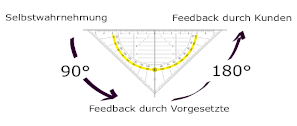
As described above, multi-rater feedback brings together different perspectives from different people assessing one person. A self-assessment is always included. This is where a little geometry comes in:
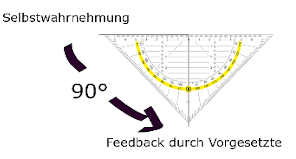
When two raters are involved—for example, the individual and customers, or the individual and their manager—this is referred to as 90-degree feedback. Adding another group makes it 180-degree feedback:
270- versus 360-degree feedback
The term “360-degree feedback” has become an umbrella term for feedback projects in which feedback about one person is obtained from several sources. Strictly speaking, however, 270-degree feedback is the most common form. Feedback is provided by managers, direct reports and colleagues, in addition to the person’s self-assessment. In 360-degree feedback, an external perspective is added—for example, from customers or suppliers.

360-Degree Feedback versus Traditional Feedback
Employees and managers receive feedback from several sources. This may be aggregated—for example, when assessing a support team or an online shop—or individual, such as feedback from a manager. Traditional feedback focuses exclusively on how others perceive the person. Conventional performance appraisal methods have often been regarded as cynical, inaccurate, subjective and, in short, unfair. By contrast, 360-degree feedback systematically gathers different perspectives and compares them with the person’s self-perception. The resulting picture of their competencies is more meaningful and less open to dispute because it does not reflect only the subjective opinion of one manager, who may have far less day-to-day contact with the person than colleagues or customers do.
Traditional feedback is generally linear and hierarchical, flowing from the top down. 360-degree feedback, by contrast, takes account of many opinions and provides an all-round assessment.
6 Valuable Tips for 360-Degree Feedback
- Involve your data protection officer or works council to gain your employees’ trust.
- Use an individual, single-use link for each participant.
- Adapt the design of the feedback questionnaire to your corporate design.
- Use the wide range of available features, such as mandatory questions, conditional display of questions or pages, and skip logic.
- Conduct the survey online, provided that your workforce can be reached by email.
- Analyse the results carefully and create a clear radar chart.
Make sure you consider data protection requirements when conducting 360-degree feedback. The Berlin Commissioner for Data Protection and Freedom of Information takes the view that assessments by colleagues may be included in employee performance reviews if the process and content are transparent to employees, personal data is collected and stored only to the extent necessary, and sustained pressure caused by monitoring is avoided. Source: Berlin Commissioner for Data Protection and Freedom of Information, Annual Report 2020
Customisable Questionnaire Template for 360-Degree Feedback
You can easily copy the 360-degree feedback questionnaire template to your own account and adapt it to your corporate design and the particular situation as required. You can find more questionnaire templates for employee surveys here.
Questionnaire Template for 360-Degree Feedback:
USER FEEDBACK
WHAT B2B CUSTOMERS SAY ABOUT LAMAPOLL

Cooperation, clarification of content, questions of implementation, finding solutions and, above all, the immediate responses to enquiries, whether by email or by phone: at LamaPoll I have experienced an absolutely outstanding example of service-mindedness. The implementation is intuitive and simple. I would recommend LamaPoll to any of my colleagues.