360-Degree Feedback: What Is It?
360-degree feedback is a method for assessing and evaluating managers’ competencies, skills and performance. This comprehensive, all-round feedback is generally used as part of employee development. The aim is to have a manager assessed from different perspectives and levels of the hierarchy in order to identify potential, initiate development processes and provide individual support for current and emerging leaders.
To obtain as complete a picture as possible of a manager’s competencies, performance and behaviour, various feedback providers—peers, line managers, direct reports, customers and others—as well as the manager themselves are first asked for their assessment. An online questionnaire, whose content varies depending on the relevant company objectives and the feedback recipient’s main responsibilities, is used to collect self-assessments and assessments from others. Questions should be clearly worded and include descriptions of observable behaviour that are as objective as possible. Depending on their department, level of seniority and other factors, individual respondents or groups should only be asked about aspects of the manager’s behaviour that they can actually observe. If a manager’s teamwork skills are being assessed, for example, colleagues can evaluate them based on observed behaviour, whereas customers or suppliers could only speculate.
Which Competencies Are Assessed in 360-Degree Feedback?
A 360-degree assessment focuses in particular on the role-relevant competencies and performance of professionals and managers. The broader competency areas examined through 360-degree feedback include:
- Goal and results orientation
- Communication skills
- Teamwork
- Planning and organisational skills
- Problem-solving and decision-making skills
- Employee motivation and development
- Persuasiveness and assertiveness
- Conflict management
- Professional and industry knowledge
Competencies are assessed using behavioural anchors: objective descriptions of observable behaviour. Examples of behavioural anchors, or indicators, for “persuasiveness and assertiveness” might include:
Manager XY ...
... can present their own point of view convincingly.
... explains decisions competently and coherently.
... takes the lead in guiding the course of discussions.
... makes well-founded and confident arguments.
Behavioural anchors for “goal and results orientation” might include:
- Sets goals and communicates them clearly.
- Checks whether objectives are achievable.
- Runs meetings in a structured and effective manner.
- Pursues goals consistently.
How Is 360-Degree Feedback Analysed?
After the 360-degree feedback has been conducted, the self-assessment and assessments from others are examined as part of the 360-degree analysis. The results are analysed in particular against the defined requirements. External perceptions and self-perception are compared, and similarities and differences are identified to reveal strengths, weaknesses and development opportunities. Presented visually, for example in a radar chart, the results might look like this:
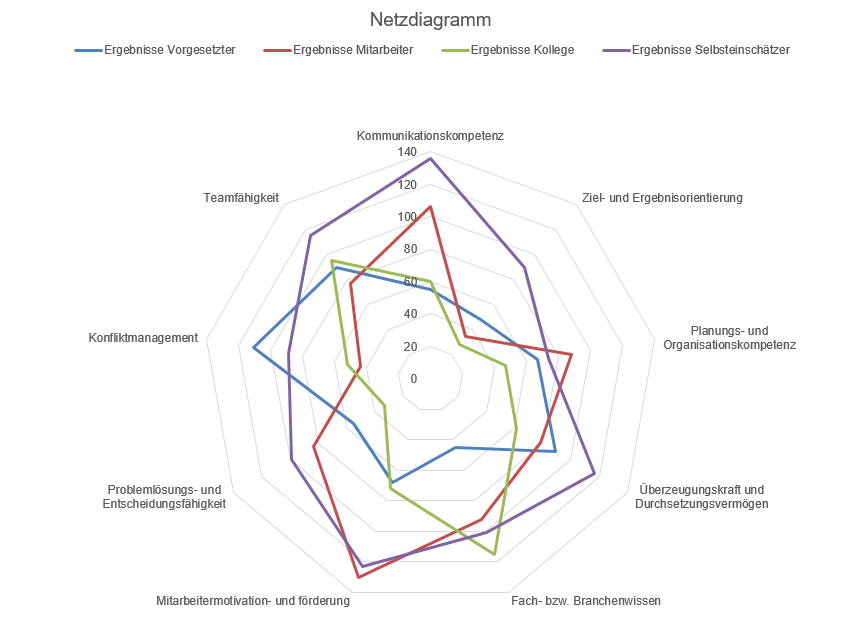
In this example, the manager rates their goal and results orientation more highly than the other feedback providers do. As part of employee development, this difference in perception could therefore be examined more closely. Should the manager’s results orientation be developed, or do they already possess this competency but communicate results poorly, for example?
The assessments of the other competency areas are then examined, compared and considered in relation to one another in the same way. They are evaluated against the role requirements and, where appropriate, used to derive individual development measures. In addition to strengths and weaknesses, untapped abilities and potential—sometimes called hidden strengths—can be identified and developed sustainably as part of employee development. In every case, the analysis of the results should focus on the development and continued growth of the manager concerned.
You can find a questionnaire template for 360-degree feedback, as well as other free employee survey templates and examples, here: Employee survey templates and examples. We have also compiled detailed instructions for conducting and analysing 360-degree feedback in our Help Centre.
Conduct 360-Degree Feedback
Now