
NPS is often inextricably linked with the concept of customer satisfaction. But what does NPS actually mean? What needs to be considered and, above all, what do critics say about it?
You can also find instructions for creating, conducting and analysing an NPS survey in our Helpdesk: Net Promoter Score (NPS).
Table of Contents
Definition: Net Promoter Score
What makes the Net Promoter Score distinctive is its simplicity. The Net Promoter Score was published in the 1990s in the book “The Ultimate Question” and is based on the “ultimate question”: “How likely are you to recommend this company to a friend or colleague?”
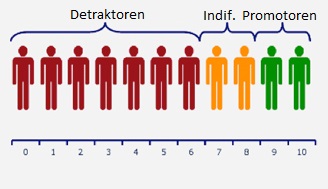
Responses are measured on a scale from 0 (not at all likely) to 10 (extremely likely). Customers are then divided into promoters, passives (indifferents) and critics (detractors) according to their response. Customers who respond with 9 or 10 are classed as promoters. Those who respond with 0 to 6 are classed as detractors. Customers who respond with 7 or 8 are considered passives or indifferents.
Net Promoter Score calculation: NPS = promoters (%) − detractors (%)
The NPS therefore ranges from plus 100% to minus 100%.
Benefits of the Net Promoter Score
Simplicity: obtain a score with seemingly little effort and no complicated formulas.
Benchmarking and comparability: as hundreds of companies calculate their Net Promoter Score, benchmark lists are available that make it easy to compare your position with competitors.
Quantifiability: management can assess your company’s performance using a simple metric.
Standardised: the Net Promoter Score is known as a standard tool for measuring and improving customer satisfaction and is used by brands such as American Express and Apple.
NPS customer satisfaction survey
Net Promoter Score benchmark
Your Net Promoter Score is 42. What exactly does that mean? An NPS of 42 sounds good. Or does it? Only by benchmarking against competitors can you determine whether your NPS is good or poor for your industry. Without a benchmark, the Net Promoter Score is only useful if it is measured continuously and at regular intervals. You can then see how your NPS changes over time following the measures you have taken.
Tips and guidance for the Net Promoter Score
- The Net Promoter Score should be measured continuously so that changes over time can be identified. This also allows you to measure the impact of PR, restructuring and marketing measures on the Net Promoter Score.
- Segment (group) your customers into promoters, passive customers and detractors to optimise communication with each group.
- Use customer surveys with the Net Promoter Score selectively, for example after support or sales calls, events and trade fairs.
- Compare the different scores by time and place of measurement to identify weaknesses in customer communication and within the company (high NPS at the point of sale, low NPS for support? Investigate further).
- Ask your customers for feedback and recommendations — not only promoters, but especially detractors.
- Respond to feedback quickly and communicate measures and results to customers.
Criticism of the Net Promoter Score
- Informative value: the Net Promoter Score is not meaningful as a single figure. An NPS of 10 results when a company has 10% promoters and 0% detractors. But it also results when a company has 50% promoters and 40% detractors.
- Industry: depending on the product and industry, customers are more or less inclined to make a recommendation. Restaurants, fashion or new lifestyle technology are frequently recommended, while washing powder or products such as underwear are recommended less often.
- Willingness versus actual behaviour: NPS measures willingness, not whether recommendations have actually been made. People often tend to signal a willingness to act without actually doing so.
- Links between NPS and company growth cannot be demonstrated. It has also been found that the relationship between NPS and customer behaviour is weaker than for other measures of customer loyalty. (Sources: S. Ruf: Würden Sie diese Methode einem Freund empfehlen? In: Verband Schweizer Markt- und Sozialforscher (ed.): Jahrbuch 2007, pp. 38–40; L. Freed: Rethinking Net Promoter: Serious Flaws Tarnish Simple Idea. ForeSeeResults white paper, 2007.)
- The NPS scale divisions are arbitrary. Why are customers who respond with 7 or 8 considered passive? After all, 8 is quite a high score.
- NPS benchmarks are primarily available from companies in the USA and the UK. This means that comparisons with German-speaking countries are only possible to a limited extent.
Using the Net Promoter Score correctly
In many companies (in English-speaking countries), the NPS concept has replaced traditional customer satisfaction analysis. Unfortunately, it is often used incorrectly or incompletely. The Net Promoter Score only appears simple, quick and inexpensive at first glance. Measuring NPS marks the beginning of a lengthy process centred on the actual “why” question. Asking why ultimately reveals the reasons behind recommendations or criticism. Without this knowledge, companies cannot take targeted action. In terms of effort and cost, the NPS concept is therefore ultimately comparable to traditional customer satisfaction measurement.
The Customer Loyalty Index (CLI) is suitable for obtaining an even more comprehensive picture of your customers’ behaviour and loyalty. In addition to willingness to recommend, this metric also measures repurchase intention and willingness to buy further products.
From the Net Promoter Score to the Net Promoter System
Research into NPS has advanced in recent years, and the term Net Promoter System is now used.
The core elements of the Net Promoter System are responses and changes within the company based on NPS:
NPS is supported by a Customer Experience Management (CEM) system.
Identified detractors are contacted with the aim of resolving the reason for their poor rating.
Promoters are identified and encouraged or involved in the product development process.
Passives are also approached specifically to convert them into promoters.
NPS is measured continuously to review the measures taken.
Thanks to the simplicity of the Net Promoter Score, a survey tool does not necessarily require any special functions. Data protection and security are therefore all the more important.