
To measure customer satisfaction reliably and obtain meaningful results, it is advisable to use established methods. Established methods include customer satisfaction surveys, measuring the Net Promoter Score, Customer Effort Score and Customer Satisfaction Score, as well as social media monitoring and the Things Gone Wrong metric. In addition to these methods, which are generally conducted online, there are others such as face-to-face surveys. The following sections introduce the established methods for measuring customer satisfaction and explain their differences, distinctive features, advantages and disadvantages.
Table of Contents
Measuring customer satisfaction: which method is right?
Measuring customer satisfaction is relevant to small and medium-sized businesses as well as large international companies, organisations and parts of the public sector. Some want to know how likely customers are to recommend them, while others want to find out how easy or difficult customers found their interaction with customer service, how user-friendly their website is or how their company is perceived. Others are primarily interested in customer loyalty and/or want to gather detailed information about their customers' needs and expectations.
The methods used to obtain meaningful results are as varied as the questions organisations want to answer. Before choosing a method, you should therefore first discuss and define the objectives of the measurement. Companies should consider what they want to examine, exactly what they want to understand from the customer's perspective and how best to reach their customers or prospective customers. They should also determine whether to measure customer satisfaction directly or indirectly, or whether to assess a customer's intended behaviour, such as recommending or repurchasing. They can then select the established method best suited to their purpose.
Measuring customer satisfaction also plays a crucial role in reputation management. Regular satisfaction surveys reveal weaknesses before they lead to public criticism or negative online reviews.
Customer satisfaction surveys
A customer satisfaction survey is a specific type of customer survey and covers a range of methods that can be used to measure satisfaction. Satisfaction surveys are now generally conducted online. This time- and cost-efficient method is also popular because it can be used flexibly. Online surveys focusing on customer satisfaction can be short and concise, perhaps consisting of just one question, or explore customer expectations and needs in detail. In every case, an engaging and concise questionnaire or online form is essential for achieving a high response rate.
An online customer satisfaction survey can be embedded on your website using an iframe, sent as a link by email or shared on social media. The customer feedback is then evaluated using relevant metrics so that suitable strategic improvements can be identified.
Example of a customer satisfaction survey embedded on a website as a pop-up:
Net Promoter Score (NPS)
The Net Promoter Score is calculated from a single question. It focuses on customers' willingness to recommend a company. The NPS assesses the extent to which a respondent would recommend a particular company, product or service to friends, relatives or colleagues. For example, the question might be: "On a scale of 0 to 10, how likely are you to recommend this company/product to a friend or colleague?" Responses are measured on a scale from 0 (very unlikely) to 10 (very likely).
When calculating the NPS, customers are divided into three categories: promoters, passives and detractors:
- Promoters (scores of 9 to 10) are enthusiastic customers and loyal advocates who continue to buy from you and recommend you to others, thereby supporting growth.
- Passives (scores of 7 to 8) are satisfied but unenthusiastic customers who may be attracted by competing offers.
- Detractors (scores of 0 to 6) are dissatisfied customers who may damage your brand and hinder growth through negative word of mouth.
The NPS is then calculated by subtracting the percentage of detractors from the percentage of promoters. In short: NPS = promoters (%) − detractors (%)
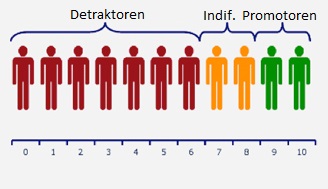
Fig. NPS customer categories
Employee Net Promoter Score (eNPS)
To determine the eNPS, a company's employees are surveyed instead of its customers. In short, the eNPS examines employee loyalty based on their willingness to recommend the company. Like the NPS, the eNPS is measured using a short survey, usually consisting of just one question, which is addressed to employees: "How likely are you to recommend company XY as an employer to friends or acquaintances?" The response scale, from 0 = "very unlikely" to 10 = "very likely", and the calculation of the eNPS are the same as for the NPS.
Would you like to learn more about the NPS? A detailed description, including tips, guidance and criticism of this customer satisfaction measurement method, is available here: Net Promoter Score
Use our NPS questionnaire template as a guide. You can copy it to your LamaPoll account with just one click. The questionnaire can also be easily embedded on your website using an iframe.
Customer Effort Score (CES)
The Customer Effort Score is an indicator that companies use to assess customer satisfaction. A single question is generally used to determine how much effort a customer had to make to obtain a solution to their issue or an answer to their question. The CES therefore does not ask directly about customer satisfaction, but instead measures how easy or difficult an interaction was from the customer's perspective.
For example, if a company wants to examine its customer service more closely, it could determine the CES by asking: "To what extent do you agree with the following statement: Customer service helped me resolve my issue quickly." Responses are given on a multi-point scale, for example from 1 = "completely agree" through intermediate options to 7 = "completely disagree". Alternatively, customers could be asked: "How easy or difficult was your most recent interaction with the company?" with response options ranging from "extremely easy" to "very difficult".
To gain more detailed insight into the effort perceived by the customer, an additional open-ended question with a free-text comment field can ask why they gave their rating or invite suggestions for improvement.
A detailed explanation of the Customer Effort Score, how it is determined and what can cause a poor score is available here: Customer Effort Score. You can also view the free CES questionnaire template.
Customer Satisfaction Score (CSAT)
The Customer Satisfaction Score measures customer satisfaction directly, using questions such as: "How satisfied are you with the product/delivery time/service?" or "How satisfied are you with the response from our customer service team?" Customers are therefore asked to indicate their level of satisfaction. Responses are given on a simple scale, generally ranging from 1 ("very dissatisfied") to 5 ("very satisfied"). Instead of numerical scales, visual scales using symbols may also be used, such as smileys, star ratings or traffic lights.
To calculate the Customer Satisfaction Score, all positive responses ("very satisfied" and "satisfied") are divided by the total number of responses and multiplied by 100. CSAT (%) = positive responses / total number of respondents × 100
Although the CSAT does not reveal why individual customers are satisfied or dissatisfied, when measured regularly it can indicate trends in average satisfaction. It can also uncover weaknesses at interaction points, such as on a website.
Use our CSAT questionnaire template as a guide. It presents several common five-point scales. Further questionnaire templates for measuring customer satisfaction are available here: customer survey templates.
Customer Loyalty Index (CLI)
While conventional customer satisfaction measurement methods focus on the current perception and assessment of a product or service, the Customer Loyalty Index (CLI) goes one step further. It measures not only how satisfied customers are, but also how strongly they remain committed to a company over the long term.
The CLI combines willingness to recommend, intention to repurchase and willingness to use additional products or services (upsell rate) into a single metric. The Customer Loyalty Index is particularly useful as a supplement to customer satisfaction analysis because it evaluates long-term customer loyalty as well as short-term satisfaction.
Social media monitoring: sentiment analysis
Social media monitoring involves interpreting signals from customers' social media interactions with a company and identifying trends. In small and medium-sized companies, employees who manage the social media channels can do this by regularly evaluating comments and reviews. Given the volume of user signals, large companies generally use automated systems and paid tools that employ algorithms to capture and assess sentiment on social media.
Another aspect of social media monitoring is searching social media for information, trends, hashtags, and user and influencer profiles that may be relevant to a company. For this purpose, companies compile a list of keywords and keyword combinations that are regularly searched for across social media channels and often on media and news sites as well. The results can, for example, reveal significant trends that can be compared with the company's own offering.
Things Gone Wrong
The "Things Gone Wrong" method records the number of complaints or claims and relates it to a specific unit, such as the number of complaints per 1,000 orders. For the chosen unit to be meaningful, it should be defined individually for each company according to its products, services, number of orders or purchases, and other relevant factors.
"Things Gone Wrong" generally refers to complaints, claims and support requests. These may be recorded internally by the customer service team or collected through an online questionnaire and evaluated regularly.
An example of a complaint form that can be embedded on your website is available here: complaint form. A template for support requests is available here: support form
Other methods
Other ways to obtain relevant metrics and measure customer satisfaction include mobile point-of-sale surveys, face-to-face surveys and computer-assisted telephone interviews. Here too, the objectives of the survey should be defined in advance and the questionnaires designed accordingly. Before conducting a telephone survey, it is also essential to ensure that each customer has given explicit and valid consent. Without the customer's consent, telephone surveys about satisfaction with a provider's services or products are considered marketing calls and are not permitted. All of these methods can be used as regularly repeated surveys as part of a trend analysis. This makes it possible to reveal long-term developments and identify future changes at an early stage.
Point-of-sale surveys (POS surveys)
As the name suggests, POS surveys are conducted where purchases take place and purchasing decisions are made. In bricks-and-mortar retail, for example, they may be conducted near the checkout. Like trade fair surveys or patient surveys, they can be conducted as a mobile online survey, for example at a terminal or on a tablet or smartphone. During or after completing a purchase, customers are invited to take part in the mobile survey and enter their answers themselves on the mobile device.
If a customer is interviewed face to face and an employee or interviewer enters their answers directly into a computer, this is known as a CAPI survey (Computer-Assisted Personal Interviewing).
POS surveys enable retailers to measure a range of factors, such as customer satisfaction with product quality or staff, as well as the reputation of the shop or its own brand. Surveys repeated regularly can also provide insight into the effectiveness of measures that have been implemented.
Telephone surveys and CATI surveys
Before conducting telephone surveys or CATI surveys (Computer-Assisted Telephone Interviewing) among prospective or existing customers, it is essential to ensure that they have given explicit consent. Telephone interviews use a questionnaire displayed on the interviewer's computer screen. The interviewer reads the questions from the screen and enters the respondent's answers into the computer.
Detailed information about CATI surveys, topics and occasions for computer-assisted interviews, questionnaire design and survey logic is available here: CATI surveys
"Telephone customer surveys about satisfaction with a provider's services are marketing calls and are permitted only with the customer's explicit consent. This also applies if the call is prompted by a customer complaint." Source: Verbraucherzentrale Bundesverband e.V.
Measuring customer satisfaction: questionnaire templates
Online surveys make it easy to measure customer satisfaction. Different questionnaires can be used depending on which metrics matter to a company. Customer satisfaction can, for example, be measured using a conventional customer survey or a questionnaire for calculating the Net Promoter Score. We also provide questionnaires for calculating the Customer Effort Score, the Customer Satisfaction Score and the extended CSAT score, including feedback. When creating customer surveys, use our free questionnaire templates designed specifically for customer satisfaction as a guide. Click "Use" to copy a questionnaire to your LamaPoll account, where you can customise it as required.

Reliable, flexible and GDPR-compliant: our clear recommendation. As a professional football club, we depend on a powerful yet user-friendly survey tool. With LamaPoll, we have found exactly that. We use the tool across the company, both internally for employee surveys and externally for customer and fan surveys. We were particularly impressed by the platform's high flexibility and ease of use. Thanks to hosting in Germany, LamaPoll also meets the highest data protection standards, which is a decisive criterion for us. The customer service is also excellent: enquiries are answered quickly, competently and in a friendly manner. We are completely satisfied and can recommend LamaPoll without reservation.