Under the NPS system, customers are divided into promoters, passives (indifferent customers) and detractors. Let us take a closer look at what this Net Promoter Score classification tells you about each of these groups. This is useful not only for assessing the current state of customer loyalty, but also for developing ways to improve it significantly.
Table of Contents
Promoters (category A customers)
Promoters should naturally always be given the highest priority. They make a substantial contribution to revenue and therefore to your company's continued success. There are a number of measures you can take to retain them, including:
- A dedicated contact person or account manager
- A premium customer card that can be combined with special terms
- Invitations to exclusive events
- Short waiting times (for example, a dedicated checkout for top customers)
- Individual offers tailored perfectly to customers' needs
- Special terms (for example, low-cost or free delivery, special offers and discounts)
Some studies have found that promoters should often be treated as premium buyers because they have strong brand awareness. These customers enjoy making purchases and usually prefer the latest product, provided they feel a corresponding sense of loyalty and affinity. This naturally varies depending on what you offer: consumer electronics and clothing, for example, are more readily replaced with newer models. Although these buyers purchase less frequently, they generally spend considerably more.
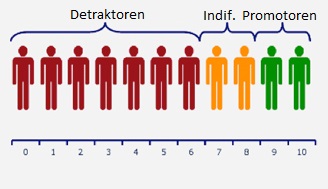
As a reminder, the following graphic illustrates how the NPS is calculated and the different customer groups:
Net Promoter Score calculation: NPS = promoters (%) − detractors (%)
The NPS therefore ranges from plus 100% to minus 100%.
Passive customers (passives)
Passive customers are important because they can become detractors if they are neglected. Their regular spending is within the normal range, although this is a relative measure. Passive customers are often people who live a minimalist lifestyle or have personal priorities in other areas of life.
You should give passive customers above-average priority, although not the same level of priority as promoters. Make an effort to turn these people into category A customers, but proceed carefully. Once they become promoters, they will expect something in return to prevent them from slipping back into passive mode.
The following measures are important for passive customers:
- General discount campaigns promoted through advertising and similar channels
- Small birthday gestures (a congratulatory email, card, voucher or small gift)
- Customer cards offering discounts once a certain spending threshold is reached
- Regular contact through advertising, newsletters and, where appropriate, promotional calls
You should also regularly communicate the benefits available to passive customers if they become premium customers. You could, for example, link premium status to a minimum annual spend and provide a range of benefits in return.
Studies show that passive buyers often shop carefully or frugally. They would usually like to spend more, but cannot always do so for various reasons. Quality nevertheless remains a clear priority, which means that brand loyalty is also high in this group. For personal reasons, however, they do not always need the latest product. It is therefore important to give these customers a reason or incentive to make the investment. Passive customers may shop more frequently than promoters, but naturally spend smaller amounts.
So-called family buyers are often part of the passive customer base. Their budget is tight, so every purchase needs to be carefully considered and weighed up several times. Their quality expectations are often higher because the product they buy needs to last longer, while their brand loyalty usually depends on their financial means. For this group in particular, discounts and special terms can turn passive customers into loyal repeat buyers.
NPS customer satisfaction survey
Detractors
Detractors are customers who generate at least a small proportion of your total annual revenue. They therefore receive the lowest priority and the associated standard level of customer care.
Special measures are generally not worthwhile here because detractors tend to be occasional or one-off buyers. They differ significantly from passive customers, whose priorities lie in other areas of life but who nevertheless remain loyal to your company to some extent. The key concern with category C customers is their strong willingness to switch providers. Even a slightly better offer could cause them to leave. You should, of course, try to prevent this, but not at the expense of preferential treatment for category A and B customers.
Make sure, therefore, that sufficient time, resources and special measures are available for every type of customer. Sophisticated marketing can certainly turn an occasional buyer into a loyal repeat customer. The only question is how much effort this requires and whether you are willing to make that investment.
Detractors can also be family buyers for the reasons mentioned above. In most cases, however, they are dedicated bargain hunters who tend to spend small amounts but buy frequently. They are highly price-sensitive, but can be attracted repeatedly through discounts and voucher campaigns. As their expectations of quality are often not particularly high and they have little brand loyalty, this also gives you some opportunities to reduce costs.