The Customer Loyalty Index (CLI) is a key metric for measuring customer loyalty and understanding long-term customer relationships. Loyal customers are far more than a reliable source of revenue. They buy regularly, remain loyal even when competitors offer alternatives and actively recommend the brand to others. This is what makes them particularly valuable: loyal customers contribute to stable revenue while also reducing the cost of acquiring new customers. Customer loyalty does not happen by chance. To strengthen it systematically, businesses need to know how to measure it, for example using metrics such as the Customer Loyalty Index.
Table of Contents
What is the Customer Loyalty Index (CLI)?
The Customer Loyalty Index is a metric that enables businesses to measure customer loyalty. It combines several aspects of the customer relationship, including customer satisfaction, into a single score and provides a comprehensive picture of how strongly customers are committed to a brand.
Unlike individual metrics such as the Net Promoter Score or repeat purchase rate, the Customer Loyalty Index considers several dimensions of the customer relationship at the same time. This makes it particularly useful when developing measures to strengthen customer loyalty.
The CLI is usually measured using customer surveys. Customers answer targeted questions about their likelihood of recommending the business, their intention to repurchase and their willingness to make additional purchases. The responses are then converted into an average score that shows how loyal customers actually are.
What does customer loyalty mean?
Customer loyalty is a customer's voluntary, long-term commitment to a business or brand. It is reflected not only in repeat purchases, but also in recommendations, positive word of mouth and active engagement with products or services, and is an important factor in a company's success. Loyal customers trust a brand's quality, service and values. They remain loyal even when competitors offer similar or cheaper alternatives because they have developed a personal connection with the brand.
The difference between customer loyalty and customer satisfaction
Customer loyalty and customer satisfaction are often used interchangeably, but the two terms describe different aspects of the customer relationship. Customer satisfaction describes a customer's current impression, in other words whether a product or service meets their expectations. Customer loyalty goes further. It develops through trust, positive experiences and emotional attachment. A satisfied customer may still choose a competitor next time despite a positive current impression. A loyal customer, by contrast, remains committed by choice.
There are many different methods for measuring customer satisfaction. Find out what they are and when to use them on our page about customer satisfaction measurement methods.
How is the Customer Loyalty Index calculated?
The Customer Loyalty Index (CLI) combines several metrics to measure customer loyalty comprehensively and provide a precise picture of customer behaviour and commitment. A single metric is usually not enough because loyalty is shaped by several factors. The CLI combines the Net Promoter Score (NPS), repeat purchase rate and willingness to make additional purchases to produce a meaningful average score.
How the CLI is measured
The Customer Loyalty Index is based on three questions answered on a six-point scale:
- How likely are you to recommend us?
- How likely are you to buy from us again?
- How likely are you to try other products or services from us, or to continue using our products or services?
Each response option is assigned a score between 0 and 100. The higher the score, the stronger the loyalty. The average of the responses to the three questions is the CLI.
| Scale | Score |
|---|---|
| 1 (very unlikely) | 0 |
| 2 | 20 |
| 3 | 40 |
| 4 | 60 |
| 5 | 80 |
| 6 (very likely) | 100 |
Formula for calculating the Customer Loyalty Index (CLI)
CLI = (score for response 1 + score for response 2 + score for response 3) / 3
Example of a CLI calculation
Suppose you conduct a CLI survey in which customers rate their likelihood of recommending you, intention to repurchase and willingness to make additional purchases on a scale from 1 (very unlikely) to 6 (very likely). One customer gives the following responses:
- Likelihood to recommend: 5
- Intention to repurchase: 6
- Willingness to make additional purchases: 4
In this example, the CLI is calculated as follows: CLI = (80 + 100 + 60) / 3 = 80. The business therefore receives a CLI score of 80 points from this individual customer, indicating high loyalty.
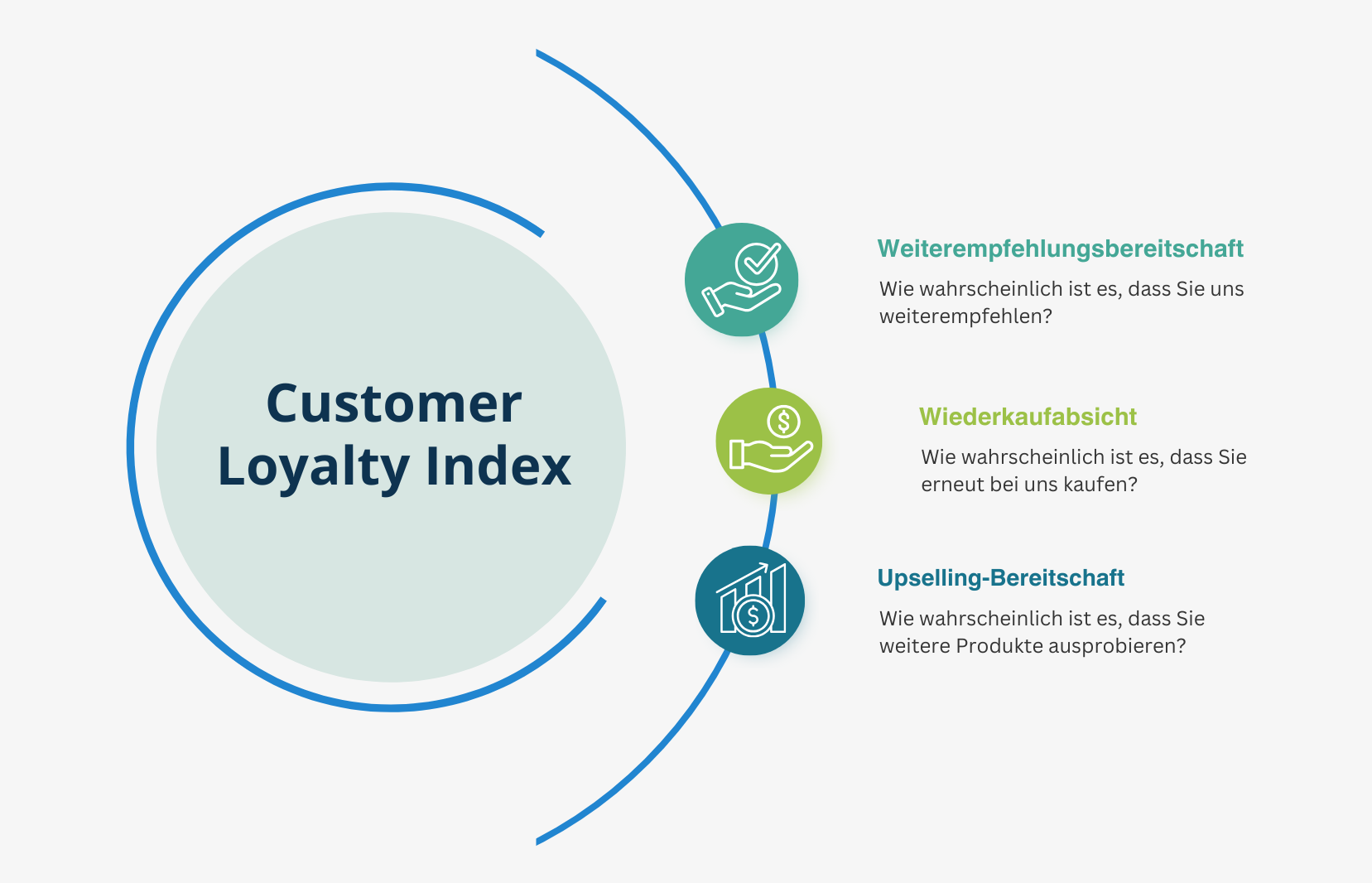
Figure: the Customer Loyalty Index and its three key aspects: likelihood to recommend, intention to repurchase and willingness to make additional purchases
The Customer Loyalty Index as an extension of the Net Promoter Score
The Customer Loyalty Index (CLI) builds on the concept of the Net Promoter Score (NPS), but goes one step further. The first question corresponds to the Net Promoter Score and measures how likely customers are to recommend a business. The additional questions on intention to repurchase and willingness to make additional purchases include further behavioural aspects that directly reflect loyalty.
This makes the CLI broader than the NPS. It shows not only whether customers are satisfied and would recommend the business, but also whether they remain actively connected to it as a result.
In short: the NPS shows whether customers would recommend a brand, while the CLI also shows whether they will remain actively connected to it, making loyalty easier to measure and compare.
Find out how to measure customer satisfaction with the NPS, including the calculation formula, how to use it and practical tips, on our page about the Net Promoter Score.
Why is it important to measure customer loyalty?
Customer loyalty is one of the most important indicators of a company's long-term success because it directly affects how stable revenue remains over time. Knowing how loyal your customers are helps you identify opportunities early and avoid risks.
The main reasons for measuring customer loyalty are:
- Identify early warning signs: Declining loyalty indicates that customers are becoming less satisfied or switching to alternatives. Take action early before valuable customers are lost.
- Unlock growth potential: Loyal customers not only buy regularly, but are also more likely to invest in additional products and services.
- Secure competitive advantages: Loyal customers stay with you even when competitors offer lower prices. This protects you from price pressure and makes revenue more stable and predictable.
- Make strategic decisions: Businesses that measure customer loyalty regularly can manage and develop measures such as loyalty programmes or personalised offers more effectively.
Other metrics for measuring customer loyalty
In addition to the Customer Loyalty Index (CLI), several other metrics provide insights into customer loyalty and can also be used alongside a CLI survey. They help assess customer behaviour from different perspectives.
- Net Promoter Score (NPS): Measures how likely customers are to recommend a business. A high NPS indicates strong emotional attachment and satisfaction.
- Repeat Purchase Rate: Shows how many customers make more than one purchase within a given period. A high rate indicates trust and loyalty.
- Customer Retention Rate (CRR): Shows how many customers are retained over a given period. The higher the CRR, the more stable the customer relationship.
- Churn Rate: Measured as part of churn management, it shows the proportion of customers who leave, cancel or otherwise stop buying. A low churn rate indicates high loyalty.
- Customer Engagement: Shows how actively customers interact with the business, for example through purchases, feedback or social media. High engagement suggests an emotional connection.
- Upsell Rate: Shows how often existing customers purchase higher-value or complementary products. It is a positive indicator of trust in the brand and its quality.
- Customer Lifetime Value (CLV): Shows the total value of a customer over the entire customer relationship. A high CLV is a direct sign of long-term loyalty.
Why the Customer Loyalty Index is so valuable
The Customer Loyalty Index (CLI) is one of the most informative metrics for measuring customer loyalty. It combines intention to repurchase, likelihood to recommend and willingness to make additional purchases into a clear overall score.
Complementary metrics such as retention rate and Customer Lifetime Value help put the results into context and provide a more complete picture of customer behaviour. Businesses that measure the CLI regularly can identify changes early, derive targeted measures to strengthen loyalty and build stable customer relationships over the long term.
Online surveys are particularly suitable for collecting a large number of customer opinions in a structured way. Regular CLI surveys provide a sound basis for analysis, improvement measures and sustainable business success.
How are CLI results analysed?
If you measure the Customer Loyalty Index (CLI) using our free questionnaire template below, you can then analyse the results easily. The template already has all the required scores assigned to the response options. Depending on the selection on the six-point scale, 0 to 100 points are assigned automatically.
To analyse the results:
- Export the raw data
To view the scores in the survey analysis, export the raw data. You can then open the file in Excel, for example. - Check the total scores
In the table, you will find the “Total score” column. It contains the sum of the three scores for each respondent.
➜ Divide this value by 3 to obtain each respondent's individual CLI score. - Calculate the average CLI
Add all individual CLI scores and divide the result by the total number of respondents.
This gives you the average CLI score for the whole survey.
Tip: You can calculate the average CLI particularly easily in Excel. Select a cell and enter the following formula:
=AVERAGE(range_of_cells_with_total_scores)/3
Excel then automatically divides the average of all total scores by three and displays the average CLI score.
Interpreting the results
- 0–40 points: low loyalty
- 41–70 points: moderate loyalty
- 71–100 points: high loyalty
Questionnaire templates for CLI, customer satisfaction and NPS
These free questionnaire templates allow you to collect customer feedback systematically as part of CLI, CSAT and NPS surveys. They provide a basis for assessing customer loyalty, customer satisfaction and customer retention. Targeted questions give you insights into your customers' experiences and expectations and show how strongly they are committed to your business over the long term. You can use this information to develop measures that strengthen trust, loyalty and willingness to recommend.