Employee retention is an essential task for employers: the aim is to retain employees and their expertise over the long term and strengthen their connection with the organisation. Employee surveys can be used to measure the level of employee retention. The findings provide a basis for developing and implementing tailored measures and tools that help strengthen it further. Here, we outline the definition and key measures for employee retention and provide relevant questionnaire templates.
Table of Contents
What is employee retention?
Employee retention, also known as staff retention, is an HR responsibility aimed at keeping employees with an organisation over the long term and counteracting staff turnover and the loss of skilled workers. As part of retention management, it involves strategically planning and managing measures that motivate employees to stay. Once highly qualified people have been recruited, organisations need to ensure that their valuable expertise remains in the business.
Why do employees stay? The reasons are individual. However, satisfied and highly engaged employees are generally more likely to remain with their current employer than unmotivated and dissatisfied employees. Employee satisfaction and strong employee engagement are therefore closely linked to retention. Positive incentives and experiences are essential if organisations are to retain highly qualified talent in the long term.
In a continuing shortage of skilled workers and the competition for talent, employee retention is indispensable for every organisation. It is also demanding, because measures must meet the differing needs of several generations of employees. Retaining Generation Z in particular can be challenging, as younger employees tend to be more willing to change employer.
Studies show that many members of Generation Z are attracted to the New Work concept. HR teams should take this into account when planning retention measures for Generation Z.
Employee retention through employee surveys
Employee surveys are a particularly suitable retention tool. They enable you to collect direct feedback about employees’ views and wellbeing, giving you a clear picture of the current situation across the workforce. This can take many forms: employee-satisfaction surveys, comprehensive annual employee surveys or regular, short-interval pulse surveys. A satisfaction survey can reveal dissatisfaction at an early stage, so that appropriate action can be taken. Taking part also gives employees the sense that they are being heard, that their views matter and that they are involved in organisational processes.
Employee surveys can also identify needs, for example around working patterns such as the four-day week or employee benefits. Surveys should be anonymous so that employees feel able to provide honest, unfiltered feedback. Online employee surveys are particularly practical: they save time and costs both when creating the questionnaire and when distributing it to the workforce.
LamaPoll provides the features needed for fully anonymous, data-protection-compliant employee surveys. Alongside traditional surveys, the tool also lets you easily create and run online quizzes, for example knowledge quizzes or team-event polls. Used thoughtfully, these can also contribute to employee retention.
For an overview of proven retention measures and information on fundamental and individual approaches to retention management, see: How to increase employee retention: proven measures.
Employee quizzes are one way to involve and retain employees. You can find examples of entertaining quizzes here: Employee quiz examples and templates.
The most important employee-retention measures
Which measures and tools should be considered in retention management to achieve strong employee retention? Measures should fit the organisation and its employer brand, as well as employees’ needs. In many cases, it is sensible to ask the workforce directly – for example through online surveys – what would help them work effectively and feel supported. The following six areas provide a framework for the most important retention measures.
1. Build a positive company and working culture
Company and working culture is one of the most important areas organisations can address. Studies continue to show that the working atmosphere strongly influences whether people stay or leave. This includes leadership and communication, relationships in teams and departments, and values such as work–life balance, sustainability and lived diversity. Practical measures include fostering cooperation, a feedback culture and appreciation; organising company events and team-building activities; and recruiting new team members who complement the existing team. Clear communication of the organisation’s goals and values is also essential, so current and future employees can identify with them and feel connected to the organisation.
2. Offer flexible working hours and ways of working
Flexible working hours and arrangements are an important way of retaining employees. For many people, flexibility is now an essential expectation of an employer, helping them balance work and private life. This applies to parents, people caring for relatives, employees with health conditions and regular appointments, and people who prefer part-time work. Wherever possible, organisations should consider options such as home working, flexitime, a four-day week, sabbaticals and workations. Flexibility – especially workations, which combine work and travel – is particularly important to many members of Generation Z. Organisations seeking to retain younger talent should give this option serious consideration.
3. Provide fair pay, bonuses and rewards
Financial compensation was long considered the central factor in successful staff retention. While salary may no longer be at the very top of every employee’s priorities, market-appropriate, performance-related pay remains essential. Bonuses and incentive payments can recognise the contribution of top performers. Employees are more likely to stay when they feel their work is rewarded fairly – or even exceptionally well.
4. Support development from the outset
Staff-development measures are also among the most important retention measures. Employees who gain confidence and personal growth in a new role or leadership position feel strengthened and motivated. Organisations should therefore offer learning opportunities and career prospects as positive incentives. In practice, retention efforts often focus on specialists with particular knowledge and skills or young people with indispensable potential for future projects. That is sensible, but measures such as job enlargement and additional qualifications can also benefit employees who are not part of this highly qualified group.
Employees’ development can often be positively influenced from the start through good onboarding, for example with a structured mentoring programme. Retention and professional development should begin as early as possible in the employee experience. Training needs assessments can help plan and deliver development opportunities that meet employees’ needs.
5. Protect employees’ health through workplace health promotion
Health-promotion measures also play a significant role in employee-retention programmes. Organisations that support their workforce’s health create a sense of wellbeing that strengthens commitment. Examples include free drinks and fresh fruit, ergonomically equipped workstations and workplace sports. Sufficient annual leave and avoiding excessive overtime matter too. Health promotion must address mental health as well as physical health: persistent physical and mental overload can lead to sickness absence and make employees more likely to seek a different employer.
As part of workplace health promotion, it is advisable to monitor and measure workload across the workforce, for example using this free questionnaire template: Workload.
Find more information about workplace health promotion as part of workplace health management here: Workplace health promotion: aims and suitable measures.
6. Offer employee benefits
Benefits, also known as corporate benefits, can help retain employees. Some health-promotion measures already mentioned – health courses, free coffee, drinks and fruit – are benefits often highlighted in job adverts. Financial support can also improve wellbeing, for example meal vouchers, travel allowances, a job ticket or a company bike. For employees who must work on site and cannot work from home, such as in production or many social-care roles, support with commuting is especially welcome. Childcare support may also be useful. The crucial point is fit: not every benefit suits every employee. It is therefore advisable to understand the workforce’s structure and, above all, employees’ needs.
Employee retention: three key tools
Employee retention should be supported by tools that match the organisation, its values and its goals. Three tools are so important that they are recommended for every organisation, because they provide the basis for suitable retention measures.
Invest in leadership development
Employers are well advised to invest time and resources in leadership development. Well-trained leaders with strong leadership and communication skills provide a stable foundation for retention measures. Leaders who establish and practise a culture of recognition, appreciation and feedback can motivate employees and create a sense of involvement and belonging. They can recognise individual team members’ potential and initiate development opportunities that help retain people in the team and organisation. Leadership development should also include working with organisational values: leaders who communicate and model these values make it more likely that employees will identify with them and feel an emotional connection to the organisation’s goals. An online 360-degree feedback survey can help measure leadership-development needs.
Implement wellbeing management
Wellbeing management is another highly relevant retention tool. It involves proactively creating the right measures for the workforce. Employees who feel comfortable and satisfied at work are more likely to engage with their tasks and remain with the organisation. Wellbeing management aims to create a positive company culture and improve the working atmosphere through collegial communication and good working conditions. Examples include team-building events, health-promotion measures and identifying and resolving conflicts in the workforce. Leaders can and should help shape it. In larger organisations, dedicated roles such as a wellbeing manager or People & Culture manager may be responsible; in smaller organisations, office-management or HR teams often take on these tasks. Whatever the precise structure, planning and implementing wellbeing management is strongly recommended.
Recruit well
Successful retention begins early in the employee life cycle: during recruitment. Thoughtful recruitment that considers candidates’ emotional connection with the organisation’s values and mission is an important retention tool. Candidates encounter the organisation’s values and goals during the recruitment process; the stronger the alignment with their own values, the easier it will be to retain them later. Recruitment is especially effective when existing team members are involved in selection and interviews. Candidates can then begin building a connection with colleagues and have a positive candidate experience. Employees involved in recruitment, in turn, experience appreciation through their contribution to significant organisational processes and decisions – which can strengthen their emotional connection to the employer.
Questionnaires for employee retention
We provide a wide range of questionnaire templates for employee surveys. Below you will find a selection of questionnaires relevant to employee retention. Feel free to use these sample questionnaires as a guide and adapt them to your organisation where necessary.
You can find further questionnaire templates for employees here: Questionnaire templates: employee surveys
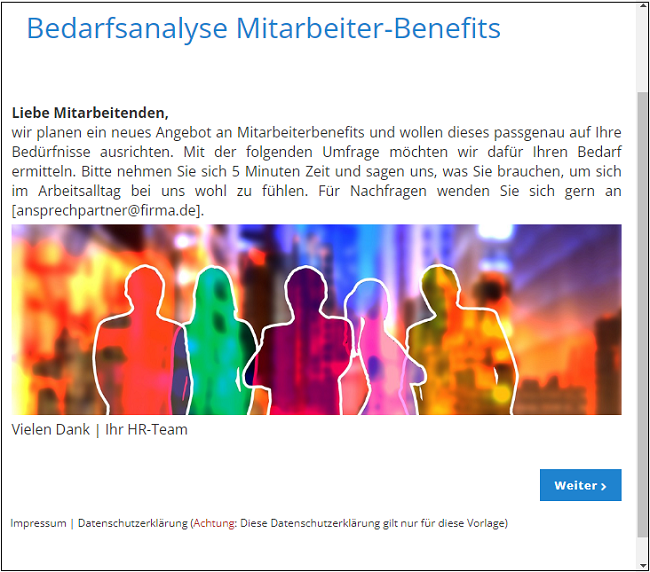
Fig. – introductory page of the “Employee benefits needs assessment” survey template
Employee retention measures: benefits and tips
What are the benefits of employee retention? Why is it so important for every organisation? And what should you consider to make retention successful?
Employee retention has many benefits
Finding and recruiting good people has become challenging and can require substantial time and cost. Against the backdrop of skills shortages, retaining existing employees is more important than ever. A key benefit of employee retention is lower staff turnover. When suitable measures build employees’ connection with the organisation, there are generally fewer resignations and departures. Employee retention also reduces recruitment costs: fewer job adverts are needed, as are fewer headhunter fees and resource-intensive selection processes. It can also positively affect employee motivation and performance and substantially improve the working atmosphere. Finally, a successful retention programme strengthens the employer brand. Motivated, engaged employees who feel connected to their employer and want to stay are more likely to recommend it to friends and acquaintances.
The benefits of employee retention at a glance:
- Reduced staff turnover and resignations
- Lower recruitment costs, including fewer job adverts, less spending on headhunters and selection processes
- Higher employee motivation and productivity
- A better working atmosphere
- A stronger employer brand
Tips for sustainable employee retention
What should you consider when retaining employees? Here are three tips for a successful employee-retention strategy:
- Consider early in recruitment how closely new talent’s values align with the organisation’s values and goals. Employees who strongly identify with the employer brand are generally easier to retain than applicants who are a poorer fit.
- Tailor employee-retention measures to the workforce’s needs. Needs assessments in the form of employee surveys can help.
- Review employee-retention measures regularly to identify improvements. Alongside employee discussions, surveys such as employee-satisfaction or employee-engagement surveys are suitable tools.
Conclusion: Building and continuously strengthening employee retention is an essential HR task for organisations of every size, especially amid ongoing skills shortages. Suitable measures and tools – such as creating a positive working atmosphere and offering flexible working patterns and development opportunities – can build commitment early, reducing turnover and resignations. Online workforce needs assessments are an established way to tailor retention measures to employees’ individual needs. The success of those measures should be reviewed regularly, for example with employee-retention questionnaires. Retaining employees across all generations is challenging and therefore requires a well-considered strategy.
Further information: How to increase employee retention: proven measures

With LamaPoll, surveys can be created quickly and easily. The tool offers many options for individual adjustments. The help pages are useful for solving many questions independently. For special requests, competent and easily accessible customer support is available.
What is LamaPoll?
LamaPoll is a survey tool for creating employee surveys and measuring employee satisfaction. You can use it to create, conduct and analyse all types of employee survey. Create your employee survey in just a few steps, apply your organisation’s corporate design and invite employees conveniently by email or via your intranet. You can quickly gain insights that help improve employee satisfaction. You can register for our survey tool free of charge and immediately conduct surveys for up to 50 employees with no obligation. If you need more responses to your online employee survey questionnaire, simply choose one of our monthly plans. You can also use our employee survey questionnaire templates and examples.