
The Customer Effort Score is one of several indicators companies use to assess customer satisfaction. It is usually measured with a single question that determines how much effort customers had to make to resolve their issue. For example: “To what extent do you agree with the following statement: Customer service made it easy for me to resolve my issue?” The following sections explain in detail what CES means, how it is measured and what you need to consider.
Table of Contents
What is the Customer Effort Score?
The Customer Effort Score (effort = exertion or work) is a metric that allows companies to examine their customer service and the quality of their customer interactions more closely. CES indicates how much effort a customer had to make to resolve their issue or obtain an answer to their question. A questionnaire for measuring CES usually consists of one core question with a predefined response scale. An open-ended question can also be added to collect customer comments or free-text responses.
The aim of a CES survey is to identify aspects of customer interactions that customers find too difficult, complicated or time-consuming. Once CES has been measured, targeted improvements can be made at these weak points.
In addition to the Customer Effort Score, companies are often interested in measuring other customer-related key performance indicators (KPIs). These include the Customer Satisfaction Score (CSAT), which can be measured using customer surveys, and the Net Promoter Score (NPS).
How is CES measured?
The Customer Effort Score is measured using a question posed to customers as soon as possible after a transaction, an interaction with customer service or the use of a service. The question should be as simple and unambiguous as possible, with answers presented on a multi-point scale from 1 to 7 (or alternatively from 1 to 5). For example, the question could be: “To what extent do you agree with the following statement? Customer service made it easy for me to resolve my issue.” Alternatively, you could ask: “To what extent do you agree with the following statement: Customer service helped me resolve my issue quickly.” The response options would range from “Strongly disagree” through intermediate levels to “Strongly agree”.
In other words, CES is not intended to measure customer satisfaction directly. Instead, it measures how difficult or time-consuming, or how easy and straightforward, customers found the service in question. However, the survey results can indirectly indicate whether a customer was satisfied or dissatisfied at a particular interaction point.
The simple core question and predefined response scale can of course be supplemented with an additional question asking why the customer gave that effort rating or inviting suggestions for improvement. An open-ended question might be: “What could we improve about our customer service?” Please note that additional questions can provide insight into possible reasons for a poor CES. On the other hand, open-ended questions may make customers feel that they have to make an additional effort, precisely what you want to avoid.
To make measuring CES easier, the LamaPoll tool already includes two ready-made CES question types among its standard elements. You can choose between a five-point and a seven-point scale for measuring CES. The wording of the question can, of course, be customised.
How is CES calculated?
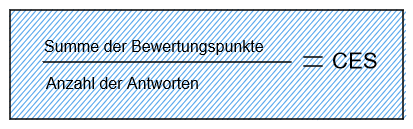
The Customer Effort Score is calculated by dividing the sum of all rating points by the number of responses, making CES an average. If you ask customers a rating question in an online survey to measure the Customer Effort Score, the score will be shown in the results. To view the Customer Effort Score in the LamaPoll tool, select “Analysis” in the left-hand menu during or after the survey, click “Results” and then select the relevant question. The Customer Effort Score is displayed under “Average values” (ø values; see figure).
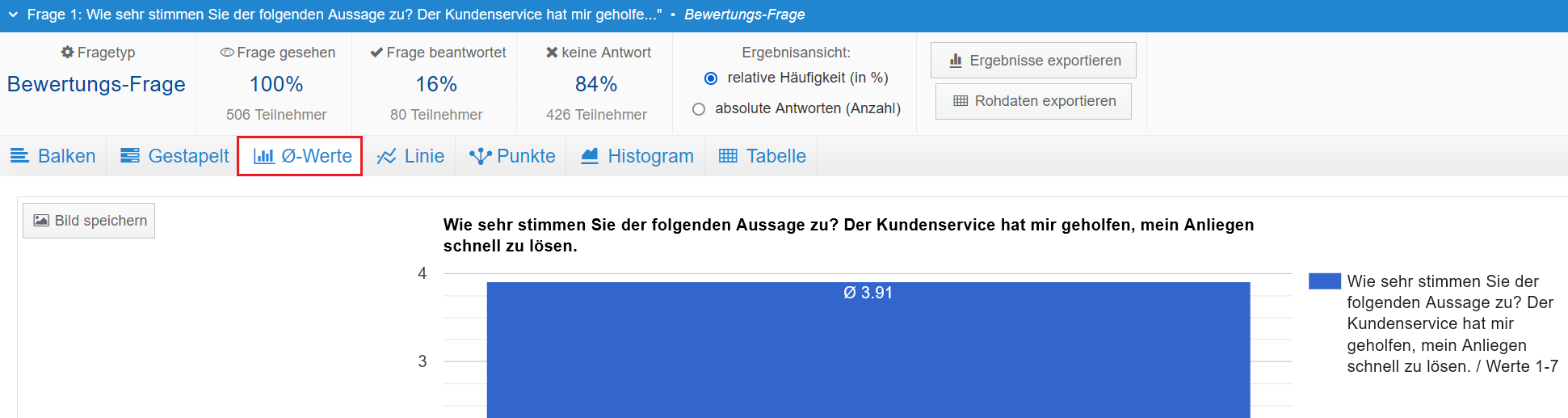
Figure: CES is displayed under “Average value” in the analysis.
CES calculation in brief: The Customer Effort Score is calculated by dividing the sum of all rating points awarded by the number of responses. The resulting average value (ø value) is the CES.
CES primarily examines customer effort, CSAT measures customer satisfaction with products or services, and NPS measures customer loyalty based on willingness to recommend. Customer effort, customer satisfaction and customer loyalty are interrelated. For example, the less effort customers feel they have to make, the more loyal they generally are.
What can cause a poor CES?
Possible causes of a poor CES include time-consuming user experiences on the website, such as lengthy booking and ordering processes, as well as inadequate service. A phone line that is constantly engaged, a form that has to be completed more than once, a customer service representative who cannot provide a satisfactory answer, or an email enquiry that receives no response or an inadequate one all make the interaction difficult for the customer.
Here are some examples of causes of a poor Customer Effort Score:
- Telephone support: permanent queues, lengthy menus, being directed to the wrong contact and repeated transfers
- Email: slow response times and poor-quality responses (generic answers, vague boilerplate text, etc.)
- Website: forms that must be completed multiple times, lengthy payment processes, insufficient or missing information and complicated navigation
- Chat service: obvious boilerplate and formulaic answers, inadequately trained staff (or immature bots) and delaying tactics when handling complaints
Resolving customer issues quickly generally results in a good Customer Effort Score and strengthens customer loyalty. According to a Harvard Business Review report, 94% of customers who felt they had made little effort intended to make another purchase. 88% said they would increase their spending.
Tips and guidance on the Customer Effort Score
- The Customer Effort Score should be measured regularly so that positive or negative effects can be identified over time. This also allows you to measure the impact of changes to purchasing processes or customer service restructuring.
- Use customer surveys with the Customer Effort Score in a targeted way, for example immediately after a chat or at key touchpoints on your website, such as after an order, booking or purchase.
- Segment (group) your customers into those who rated their effort as low and those who felt it was high. This allows you to tailor your communication to each group.
- Respond to feedback, take appropriate action and let your customers know when you have introduced new services or improved existing ones.
Questionnaire template for measuring CES
Use our free questionnaire template as a guide when creating your online questionnaire. You can copy it to your LamaPoll account with a single click and modify it there if required. You can find more questionnaire templates for a wide range of customer and employee surveys here: questionnaire templates

Reliable, flexible and GDPR-compliant: our clear recommendation. As a professional football club, we depend on a powerful yet user-friendly survey tool. With LamaPoll, we have found exactly that. We use the tool across the company, both internally for employee surveys and externally for customer and fan surveys. We were particularly impressed by the platform's high flexibility and ease of use. Thanks to hosting in Germany, LamaPoll also meets the highest data protection standards, which is a decisive criterion for us. The customer service is also excellent: enquiries are answered quickly, competently and in a friendly manner. We are completely satisfied and can recommend LamaPoll without reservation.