
A sound trend analysis provides data-based insights into developments and market movements and helps organisations make forward-looking decisions. In a world where markets and customer needs are constantly, and often rapidly, changing, it is an important way to understand change rather than simply observe it. This is particularly relevant in a digital environment, where opinions and information spread in real time. Organisations that identify trends early can gain a competitive advantage, develop products more effectively and optimise their marketing strategies. But how can relevant developments be identified? Find out which methods are available and how online surveys can help generate valuable insights. You can also use our questionnaire templates to get started quickly with trend analysis.
Table of Contents
What is trend analysis?
Trend analysis: the most important methods
To conduct a sound trend analysis, it is important to understand the different methods available and select approaches that fit the organisation’s objectives and industry. In many cases, combining several approaches gives a more complete picture. Qualitative methods such as traditional market research, expert interviews and social media monitoring can help identify emerging developments and customer opinions at an early stage. Quantitative methods such as surveys and data analysis provide robust figures on how trends are developing. Combining both approaches helps distinguish relevant trends from short-lived phenomena. The seven most important methods are summarised below:
- Online surveys: Online surveys are one of the most efficient ways to collect targeted data and identify trends early. They allow organisations to gather direct feedback from customers and target groups without relying solely on indirect data sources. Their flexibility is a particular advantage: surveys can be adapted to specific questions and used in different formats, from short pulse surveys to detailed market research studies. LamaPoll makes it easy to create surveys and combine the resulting data with other methods for well-founded trend analysis.
- Delphi method: The Delphi method is an established approach in trend analysis and market research. It is based on several survey rounds with a selected group of experts whose assessments are evaluated systematically. It is particularly useful for complex questions or uncertain future scenarios and can also be carried out efficiently using online surveys.
- Social media monitoring: Analysing social media posts, hashtags and interaction rates can help identify current developments. Organisations can see which topics are gaining relevance and which are likely to remain short-lived hypes.
- Competitor analysis: Monitoring competitors can provide valuable insights into new trends, successful strategies and changing market conditions. This can include analysing new products, marketing campaigns or shifts in customer behaviour.
- Google Trends and search query analysis: Search queries often reflect changes in people’s interests at an early stage. Google Trends provides a straightforward way to track the popularity of search terms over time and identify seasonal patterns or longer-term developments.
- Sentiment analysis: This method examines the attitude or sentiment expressed in customer reviews, comments and forum posts. Organisations can use it to understand how opinions about particular topics, products or brands change over time and respond accordingly.
- Crowdsourcing and community insights: Directly involving customers and communities can help identify new ideas, needs and trends early. Dialogue with an engaged target group provides valuable qualitative data for strategic decisions.
Whatever method is used, it is particularly useful to review relevant data sources in a structured and recurring way. Trends are often not defined by dramatic changes, but by subtle shifts that only become visible in the overall picture. Organisations that regularly review and adapt their analysis processes create the basis for identifying opportunities before they become mainstream, rather than simply reacting to change.
Qualitative methods provide insights into attitudes, needs and opinions, while quantitative methods make these impressions measurable and comparable.
How do online surveys support trend analysis?
Surveys are one of the most reliable ways to identify changes in markets, customer needs and wider social developments at an early stage. While other analytical methods often rely on historical data, surveys provide direct feedback from the target group and can be used to understand employee needs or ask customers about their expectations. Targeted surveys can confirm existing trends and reveal emerging developments before they become widespread. Key advantages of using surveys for trend analysis include:
Targeted questions
Surveys can be tailored to collect information on specific topics. Organisations can determine which changes matter to their target group and use the results to make informed decisions.
Real-time feedback
In the digital age, trends can emerge and change very quickly. Online surveys make it possible to capture opinions and sentiment in real time, allowing organisations to respond quickly to new developments.
Data export for deeper analysis
Survey data can be exported to analysis tools such as SPSS or processed further in Excel. This makes it easier to identify patterns and longer-term developments that can support strategic decisions.
Segmenting results
Not every trend affects every target group in the same way. Analysing results by different criteria can reveal differences between groups and support more targeted strategies for individual customer segments.
Testing hypotheses
Online surveys provide a simple way to test initial assumptions about new trends or ideas. Organisations can formulate specific hypotheses, for example about the acceptance of new features or design trends, and validate or refine them using direct feedback from the target group.
Identifying target-group priorities
Surveys can help determine which trend topics genuinely matter to the target group and which are mainly amplified by media coverage. This allows organisations to focus resources on developments with real potential.
Export data from your online survey for SPSS: Our blog article explains how to export LamaPoll survey data in the correct format for the SPSS statistics software.
How to conduct trend analysis with online surveys
To gain meaningful insights into current and future trends with an online survey, it is important to follow a structured process. Careful planning helps ensure that the data collected is both relevant and useful for decision-making. The following steps can help you conduct a sound trend analysis and use the resulting data effectively. A systematic survey structure ensures that relevant aspects are covered and supports both a deeper understanding of the target group’s views and needs and a precise analysis of the results.
Step 1: Define the objective and research question
A precise research question and target-group analysis help sharpen the focus and ensure that relevant data is collected.
- Do you want to understand customer or employee needs better?
- Do you want to identify new market trends?
- Do you need insights into particular products, services or target groups?
Step 2: Create the survey and choose suitable question types
Questions should be clearly worded and aligned with the objective of the analysis. The following question types can be useful:
- Scale questions: to assess trends or products, for example “How important is ... to you?”
- Multiple-choice questions: to allow several answer options and capture a broader range of opinions.
- Open questions: to collect qualitative insights, for example “Which trends do you see in your industry?”
- Ranking questions: to identify priorities within a target group.
Step 3: Analyse data and identify trends
Once enough responses have been collected, the results can be analysed. Useful approaches include:
- Quantitative analysis
- Comparing responses across different target groups
- Analysing changes over time
- Identifying recurring patterns and developments
- Evaluating open responses to uncover new ideas and trends
Step 4: Turn insights into strategy
The findings can feed into corporate or marketing strategy. This may include:
- Adapting products or services to new needs
- Optimising marketing campaigns based on current trends
- Identifying risks and market changes at an early stage
- Adapting internal processes to new working models and expectations
Before starting your trend analysis, it is worth checking the quality of your survey. Conducting a pretest before launch helps ensure that your results are robust and provides a stronger basis for meaningful trend data.
Create a trend analysis questionnaire
Time series analysis as a basis for trend analysis
Time series analysis is a statistical method for examining data collected over a defined period. It helps identify patterns and recurring developments and can be used to forecast future trends. The method is used in many areas where data is collected over time, for example when analysing changes in customer satisfaction, employee satisfaction or consumer behaviour. Time series analysis can also form part of other methods. Social media trends can be observed over longer periods, changes among competitors can be analysed, and shifts in consumer preferences can be tracked using survey data. The following chart uses household consumer spending as an example of what a time series analysis can look like.
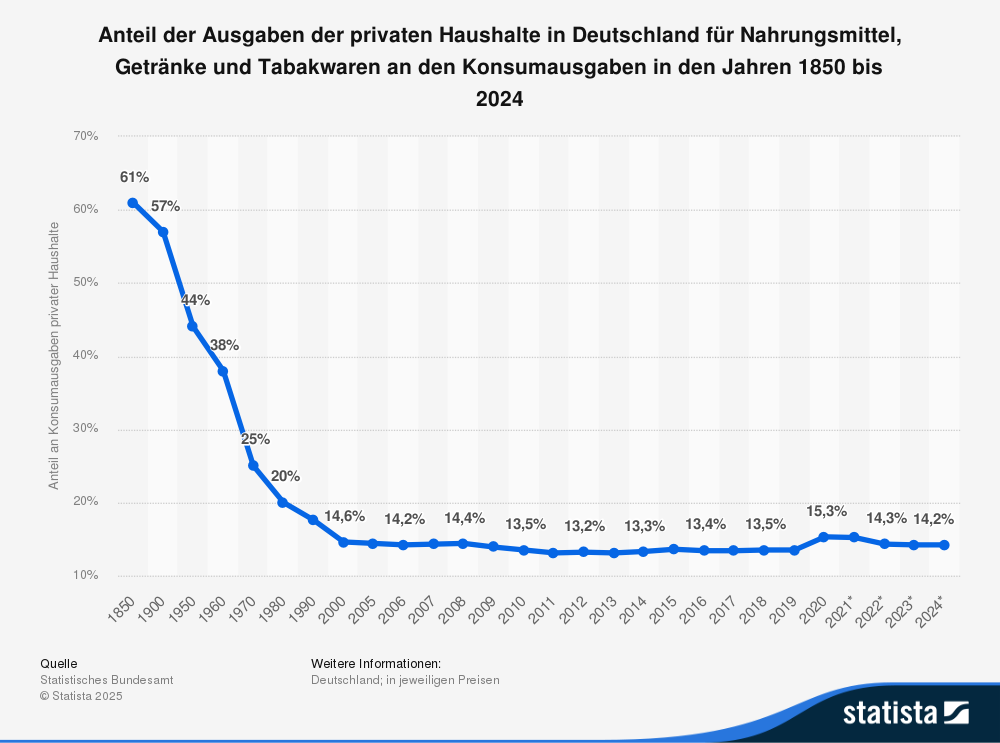
Time series analysis using household consumer spending as an example © Statista
Various programs can be used to conduct and evaluate time series analyses. SPSS can be used for complex time series analysis, including the analysis of historical data and forecasts of future developments to support data-based decisions.
Importance and examples of trend analysis
Trend analysis can be a valuable tool in almost any industry for identifying and assessing developments at an early stage. It can be used in consumer goods, marketing and many other service sectors. The key is to ask the right questions and turn the results into concrete action. The following examples show how trend analysis can be used in practice and what insights it can provide.
Gain a competitive advantage
Organisations that identify trends early do not have to rely solely on following competitors. In retail, for example, trend analysis can help determine which products and designs are likely to be in demand in the coming season, allowing an organisation to position itself as an early mover.
Understand customer needs
As trends develop and change, customer expectations change too. An e-commerce business can use surveys to collect feedback on existing products and respond more specifically to customer needs. This makes it possible to analyse which expectations and requirements are likely to become more important in future.
Develop effective marketing strategies
Understanding which topics, channels and formats are currently relevant helps organisations address their target groups more effectively. Analysing viral content, new platforms and search queries can provide a basis for targeted marketing measures and improve campaign relevance.
Use resources efficiently
Rather than investing in short-lived hypes, trend analysis can support well-founded investment decisions and more targeted use of budgets. Organisations can use trend analysis to prepare for future demand and shifts in consumer preferences.
Identify crises and risks early
Market changes, new competitors and changing expectations among skilled workers can create potential risks. Trend analysis can help identify which working-time models are becoming more important and allow organisations to adapt to changing employee needs.
Improve communication
A sound trend analysis not only supports decision-making but can also improve communication within an organisation. When teams work from a shared evidence base, objectives become clearer and measures can be better coordinated. Externally, the analysis can also help organisations formulate marketing messages more precisely, explain product development more transparently and support strategic decisions with evidence.
A well-conducted trend analysis gives organisations greater confidence in planning and helps them act on opportunities before they become standard practice. By continuously monitoring and evaluating market developments, organisations can develop long-term strategies based on sound data rather than short-term reactions. This can reduce risk, identify innovation potential earlier and help business models adapt to changing conditions.
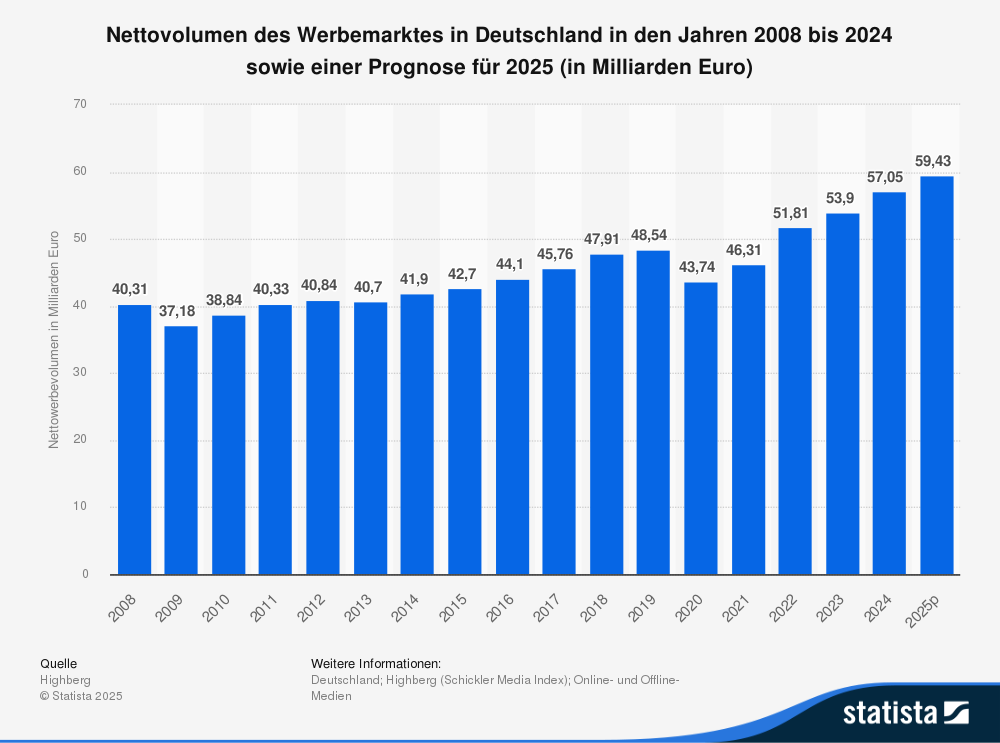
Example of a trend analysis with forecast © Statista
Not every short-lived hype is a worthwhile investment. Look for recurring patterns and longer-term developments to identify trends that are genuinely relevant to your organisation.
Best practices for trend analysis
To conduct an effective trend analysis and make good use of the resulting data, several established practices are worth following. One is to define clear objectives: what exactly should the analysis reveal? Choosing appropriate data sources is equally important and will depend on whether the focus is on market trends, customer behaviour or technological developments. Regularly updating the data and critically assessing its relevance and quality also improves the value of the analysis. The following best practices help improve analytical quality and ensure the results are genuinely useful.
- Collect data regularly: Trends are constantly evolving, so analysis should be repeated at suitable intervals. The frequency should reflect how dynamic and fast-moving the industry is. Additional data collection can also be useful after particular events, such as a product launch. For employee satisfaction surveys, an annual cycle may be appropriate. Repeated surveys and data analyses make it possible to observe longer-term developments and respond to change in good time.
- Combine different analytical methods: Surveys should be combined with other data sources to provide a more complete picture of current trends. Social media monitoring, market analyses and customer feedback provide additional perspectives that can enrich the analysis.
- Ask clear and neutral questions: Question wording has a major effect on the quality of survey results. Imprecise or leading questions can distort responses, so clear and neutral wording is essential for valid and objective data. A neutral example would be: “How satisfied are you with product XY?” By contrast, “How much do you value the quality of our product?” already implies that the product is high quality and may reduce the likelihood of an honest response.
- Segment data deliberately: Trends can vary substantially between target groups. Results should therefore be segmented by relevant characteristics such as age, gender or region. This enables a more differentiated analysis and supports targeted measures for different groups.
- Act quickly on findings: A trend analysis is only valuable if its findings are translated into concrete action. Timely implementation can improve competitiveness and also show customers and employees that the organisation responds to their needs.
Overall, a trend analysis is only as useful as its implementation. A structured process, well-designed questions and careful interpretation can provide valuable insights and support informed decisions. Repeating the process regularly and reviewing findings over time helps reveal not only isolated developments but also longer-term changes. Flexibility is equally important: trends are dynamic, and methods for collecting and analysing data should be reviewed and adapted continuously. This turns trend analysis into an integral part of strategic planning rather than a one-off snapshot.
Questionnaire templates for trend analysis
An online survey can be a useful first step in trend analysis because it allows you to collect direct feedback from the target group. Our free questionnaire templates provide a practical starting point: add a template to your LamaPoll account and adapt it to different topics and target groups. The following templates can help you gather initial insights quickly and provide a basis for sound analysis. More questionnaire templates for a wide range of use cases are available on our questionnaire templates page.
Questionnaire templates for market research
These templates support the structured collection of data on markets, brands and products. They can be used, for example, to analyse customer preferences, brand awareness and product experiences, providing a solid basis for strategic decisions.
Questionnaire templates for customer surveys
These templates help you collect customer feedback systematically. They provide a useful basis for assessing satisfaction, service quality and customer loyalty by giving you targeted insights into your customers’ expectations and experiences. This allows organisations to derive well-founded measures to improve their services and products.
Questionnaire templates for employee surveys
These templates help you collect valuable employee feedback systematically. They provide a basis for assessing employee satisfaction, the working environment and company culture. Targeted questions give you insights into employees’ perspectives and help you identify strengths and areas for improvement. You can then take focused action to strengthen motivation and employee retention.
Conclusion on trend analysis
Trend analysis helps organisations identify developments early and respond strategically. It is based on the systematic collection and analysis of data gathered through different methods. The key is to collect information regularly, assess results in context and turn them into concrete action. This helps organisations make targeted use of opportunities and base long-term decisions on reliable data.

We have already been able to run several internal and external customer surveys. It was important to us to have an easy-to-learn, uncluttered tool that provides common question types and still produces attractive surveys on all devices. Data security naturally also plays a major role. LamaPoll offers all of this. 5 stars!
What is LamaPoll?
LamaPoll is an online survey tool for creating employee surveys and measuring employee satisfaction. With us, you can create, conduct, and analyse all types of employee surveys.
Set up your employee survey in just a few steps, customise it with your company's corporate design, and invite your employees conveniently by email or via your intranet. You'll gather insights to boost employee satisfaction in no time. Sign up for free with our online survey tool. You can then run surveys for up to 50 employees immediately and with no obligation. If you need more responses for your online employee survey, simply use our monthly plans. You can also make use of our templates and examples for employee survey questionnaires.