
Feedback from consumers on products and services is an important indicator of customer satisfaction and helps inform planning and further development. As part of product management, companies can assess customers’ needs and expectations through methods such as customer surveys. Actively collecting feedback through online surveys helps companies plan products around customer needs, develop them for the right target groups and increase the likelihood of purchase.
Table of Contents
For manufacturers, feedback from consumers on their own products is highly valuable. It is often gathered from potential customers before a new product is launched. During product design and development, conjoint analysis can be used at an early stage to identify which product variants consumers prefer. This involves assessing the importance of individual product attributes as well as gathering feedback on combinations of those attributes. The results help identify preferred combinations that can then inform product development.
Feedback surveys can also be used before launch to estimate purchase likelihood. Consumers, including existing customers and potential buyers, are shown the key features of a prototype in a questionnaire using text and/or images. Respondents are then asked to indicate on a scale how likely they would be to buy the product once it is launched.
The purpose of this type of feedback is generally to develop or optimise products around customer needs. The results can also provide insight into emerging trends, perceptions of the company or demand for specific product features.
Using product evaluation to guide improvements
Product tests and launches can also be supported by feedback surveys. Relevant target groups are invited to take part in online surveys and assess the products. This allows both new products and products already on the market to be evaluated for market readiness. Customer feedback can show, for example, whether a product meets market requirements and is accepted by potential buyers. Product evaluation therefore provides a basis for customer-focused development and optimisation, with the aim of increasing purchase likelihood.
The aim of product evaluation is to generate relevant data that can be used to adapt products to specific target groups and improve pricing. Potential customers may, for example, be asked in a feedback questionnaire to assess a product’s quality, value for money and usefulness. Surveys can also ask how likely respondents are to buy the product and/or recommend it to other consumers. Manufacturers can also evaluate a product’s image. One common method is a semantic differential, where consumers rate the product on a scale between pairs of opposing terms, such as boring versus interesting or ordinary versus exclusive.
You can copy our free questionnaire templates into your LamaPoll account with a single click: Free questionnaire templates
Conducting a pain point analysis
Surveys can be used to identify customer pain points directly or indirectly. Pain points include problems with a product or service that inconvenience or frustrate customers. Companies should take these issues into account in product development so that new or improved products address genuine customer problems.
Pain points can also occur at touchpoints along the customer journey. Recurring problems at these points of contact with potential, existing or former customers, such as difficulties during the online checkout process, can lead to abandoned purchases. Companies should therefore identify and, where possible, eliminate them. Customer surveys can help reveal both these pain points and customers’ expectations.
Examples of pain points:
- The ordering process is too complicated
- Payment takes too long
- Customer service is difficult to reach
- The support team responds too slowly
- The product does not meet expectations
- Important product features are missing
- Value for money is unsatisfactory
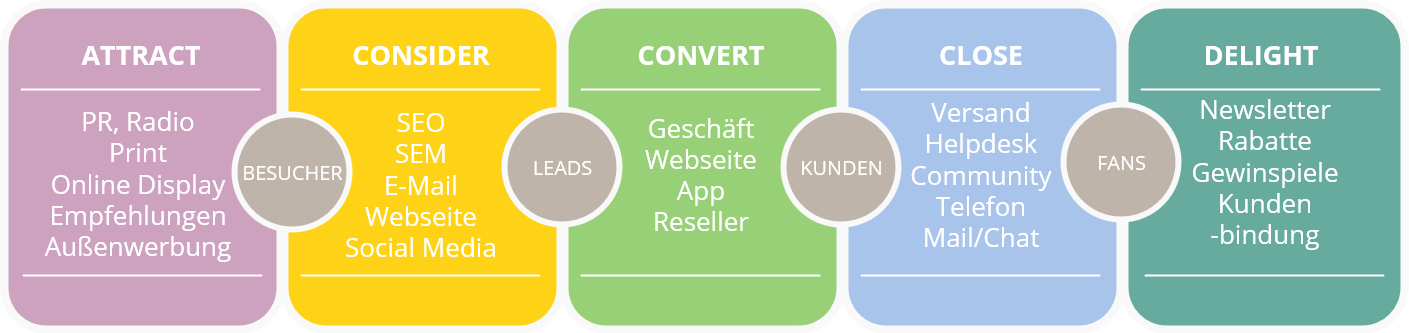
Fig.: Touchpoints along the customer journey that can be analysed for pain points.
Product feedback questionnaires
Feedback questionnaires can be used in a targeted way throughout product management. The customer feedback collected can help estimate purchase likelihood and reveal consumer preferences.
Product feedback questionnaires can help you:
- collect realistic data during product development
- determine the utility of individual attribute levels
- identify consumer preferences
- assess demand
- estimate purchase likelihood
- optimise products based on consumer preferences
- assess price elasticity
- develop and improve products around customer needs
When creating a product feedback questionnaire, you can use our free product launch feedback template or our product satisfaction template as a starting point.
What is LamaPoll?
LamaPoll is an online survey tool for creating employee surveys and measuring employee satisfaction. With us, you can create, conduct, and analyse all types of employee surveys.
Set up your employee survey in just a few steps, customise it with your company's corporate design, and invite your employees conveniently by email or via your intranet. You'll gather insights to boost employee satisfaction in no time. Sign up for free with our online survey tool. You can then run surveys for up to 50 employees immediately and with no obligation. If you need more responses for your online employee survey, simply use our monthly plans. You can also make use of our templates and examples for employee survey questionnaires.