Customer surveys can be used at many different points in the customer journey: before a purchase, directly after an order, during a service interaction or throughout a longer-term customer relationship. The key is to match the right survey timing with the right objective. This page shows typical applications, suitable touchpoints and practical examples.
Contents
Points of contact between companies and customers
Online customer surveys can be used at both digital and face-to-face touchpoints. On websites and in online shops, surveys can be embedded directly or shown after an interaction. By email, customers can be asked for feedback following a purchase, delivery or service interaction.
Online surveys can also be used at offline touchpoints. In physical shops, at trade fairs, events or in waiting areas, customers can take part via a QR code or a tablet provided on site.
TIP: Choose the access method to suit the situation. A short link or QR code works well for spontaneous feedback on site, while email is better suited to more detailed surveys following a specific interaction.
Customer touchpoints throughout the purchasing process
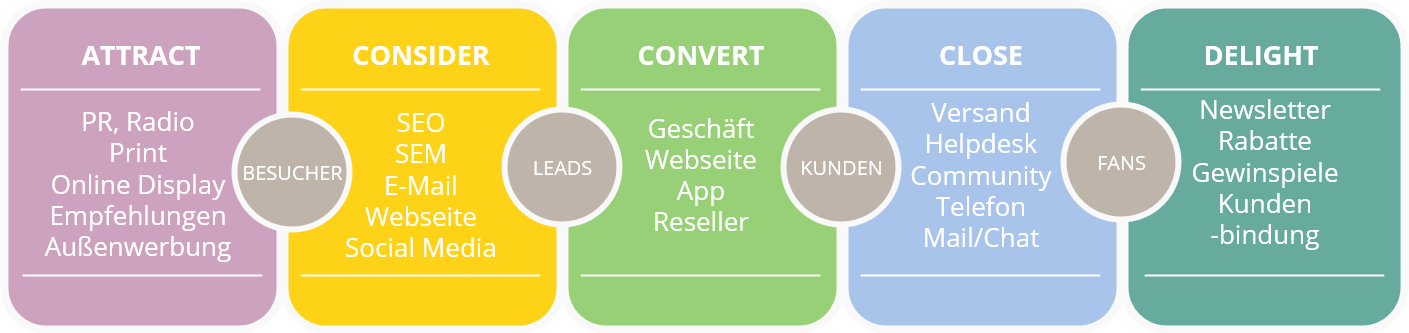
Companies and customers interact at different touchpoints before, during and after a purchase. Before a purchase, these may include adverts, social media or the company website. During the purchase, relevant touchpoints include the online shop, a physical store or a consultation. After the purchase, they may include delivery, product use, customer support or newsletters.
The most suitable survey depends on what you want to learn. Immediately after an interaction, short and specific questions about that experience are often appropriate. For broader topics such as customer satisfaction, customer loyalty or product development, more detailed surveys at longer intervals may be more useful.
Relevant survey touchpoints can occur throughout the customer lifecycle. When asking about a specific interaction, it is usually best to ask soon afterwards, while the experience is still fresh in the customer's mind.
Which touchpoint is suitable for what?
| Touchpoint | Suitable for |
|---|---|
| Before the purchase | Expectations, information needs and potential barriers to purchase |
| Directly after the purchase | Ordering process, checkout and initial satisfaction |
| After delivery or use | Product quality, user experience and satisfaction |
| After a service interaction | Service quality, problem resolution and Customer Effort |
| Regularly | Customer loyalty, satisfaction and changes over time |
Examples of customer surveys at different touchpoints
Online surveys are particularly useful when customers can be reached through digital or easily accessible channels such as email, a website or a QR code. The right channel depends on when the feedback is collected and the context in which customers are being asked.
Typical locations and survey situations
E-commerce
After an order, delivery or contact with customer support, customers can be asked directly for feedback. Suitable channels include email, newsletters or a survey embedded in the website. This makes it easier to relate the feedback to a specific touchpoint.
Physical retail
Online surveys can also be used in store, for example via a QR code on a receipt, flyer or poster, or on a tablet provided on the premises. The important point is to make access as simple as possible and keep the survey short enough for the situation.
Trade fairs and events
At trade fairs or events, visitors can be surveyed directly on site, for example using a tablet or QR code. Short surveys work well for questions about interest, expectations or the event experience. More detailed feedback can then be collected by email afterwards.
Healthcare
Patient surveys can be used after an appointment or stay to gather feedback on processes, communication or service. Participants can access the survey via a QR code, a link or a device provided on site.
Further applications of customer surveys
Beyond traditional customer satisfaction surveys, customer surveys can be used for a wide range of other questions. The following applications link to more detailed information:
- Requirements elicitation and analysis: systematically identify customer requirements and expectations
- Needs analysis: identify which products, services or improvements customers actually need
- Feedback in product management: develop products and features based on real user experiences
- Website relaunch feedback: assess how users perceive the structure, content and usability of a website
- Churn management: identify reasons why customers leave
- Customer Effort Score: measure how easy or difficult an interaction was for customers
You can also use our customer survey templates, which you can copy to your account and adapt as required.
Possible objectives of customer surveys
Typical objectives of customer surveys include:
- measuring customer satisfaction
- identifying problems at individual touchpoints
- improving products and services
- strengthening customer loyalty
- understanding reasons for purchase or churn
- tracking changes over time
For a more detailed explanation of suitable objectives and how to define them, see objectives of customer surveys.