Pretests are an important part of preparing online surveys. Running a test in advance helps you identify weaknesses and potential errors before the survey goes live. This safeguards the quality of your results and prevents unpleasant surprises during analysis. It applies equally to employee surveys, customer surveys and academic studies. A professional survey plan should therefore always include a pretest, regardless of the target group or intended use. To make the process easier, we provide a pretest questionnaire template that lets you collect feedback in a structured way. On this page, we explain what matters when conducting a pretest and why it is always worth the effort.
Table of Contents
What is a pretest in an online survey?
By definition, a pretest is a trial run in which a questionnaire or research instrument is tested with a small group before it is used in the main study. Its purpose is to identify sources of error and weaknesses at an early stage, before they distort the results or make them difficult to analyse. The aim is not to collect robust data at this point, but to review and improve the quality of the instrument itself.
A pretest is particularly important for online surveys. It not only helps uncover misunderstandings in the questions, but also checks whether the technical implementation works as intended. This ensures that participants understand your survey correctly and can complete it without technical problems. A carefully conducted pretest therefore lays the foundation for meaningful and reliable results.
|
Problem |
How it manifests itself |
Consequences |
|---|---|---|
|
When answering: |
||
|
|
|
|
| During analysis: | ||
|
|
|
|
| Comprehension: | ||
|
|
|
|
| Length: | ||
|
|
|
|
According to a study by Tuten et al. (2002), up to 80% of participants abandon online surveys early if, for example, question types are too complex. A structured pretest can prevent these peaks in drop-out rates by revealing problem areas before the main survey begins.
How to conduct a survey pretest step by step
A pretest should be carefully planned and structured so that its findings are genuinely useful. In this section, we show you the best way to proceed, what to look out for and which specific options LamaPoll offers.
- Finalise the survey
Make sure your questionnaire is complete, both in terms of content and technology. This includes the question wording, layout and, where applicable, skip and filter logic.
- Select suitable test participants
Your test participants should resemble the eventual target group as closely as possible and should not have been involved in creating the survey. Particularly for surveys containing images or videos, it is advisable to test them on different devices. - Distribute the survey to test participants
Send the invitation link with a brief explanation of what participants should pay attention to. This can help ensure that their subsequent feedback is more structured and useful. - Create and provide a pretest questionnaire for feedback
Ask specific follow-up questions about the survey’s clarity, overall impression and effect. The pretest questionnaire should be completed immediately after the test survey. - Collect observations and feedback
Record any technical problems, unusually long response times or drop-outs during the test. You can supplement these observations with targeted follow-up questions or add relevant questions to the feedback questionnaire in a second round. - Analyse the feedback questionnaire results
Organise the feedback by topic: technology, clarity, effect or process. Recurring comments are a clear indication that improvements are needed. Individual opinions are important, but should always be considered in relation to the overall picture. - Act consistently on the findings
Revise the questionnaire based on the feedback, changing the wording, response options or technical settings where necessary. If you have made substantial changes, it is worth running a second pretest. This ensures that the new adjustments work as intended.
Our helpdesk explains in detail how to test your survey and conduct a pretest: Test a survey. The step-by-step guide takes you through the entire process, from the technical setup and distribution to the steps to take after the pretest.
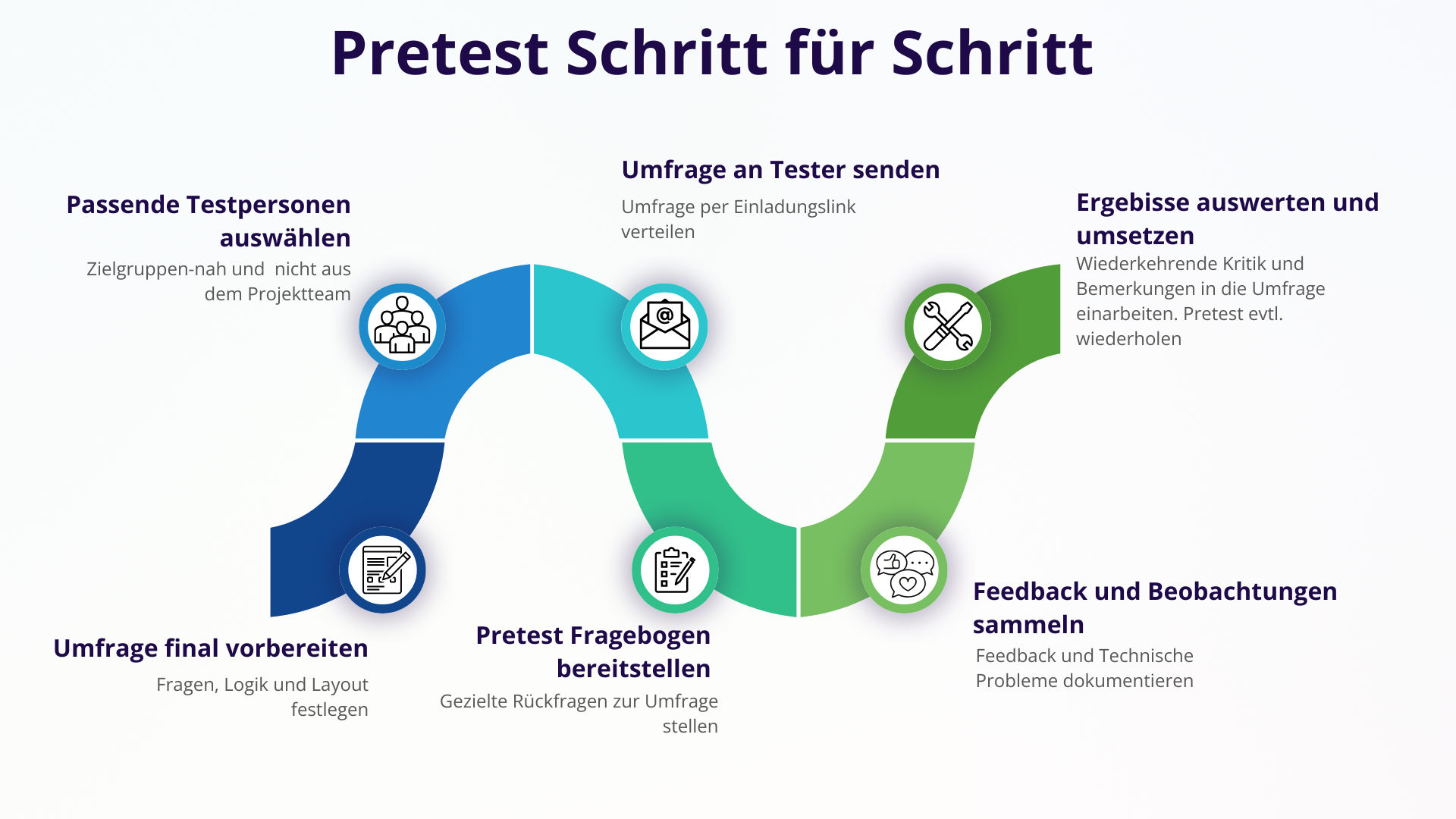
Figure: The individual steps of a pretest
Conduct a pretest with LamaPoll
As a useful addition to a pretest questionnaire, you can use the commenting feature in the LamaPoll editor. It allows comments to be added directly to each element. From the Gold plan onwards, you can also add employees to your account so they can provide feedback on individual questions and leave comments. This makes it quick and easy to review wording, response options and skip logic. We show you where to find this feature here. You can read more about how to use the commenting feature in our blog post.
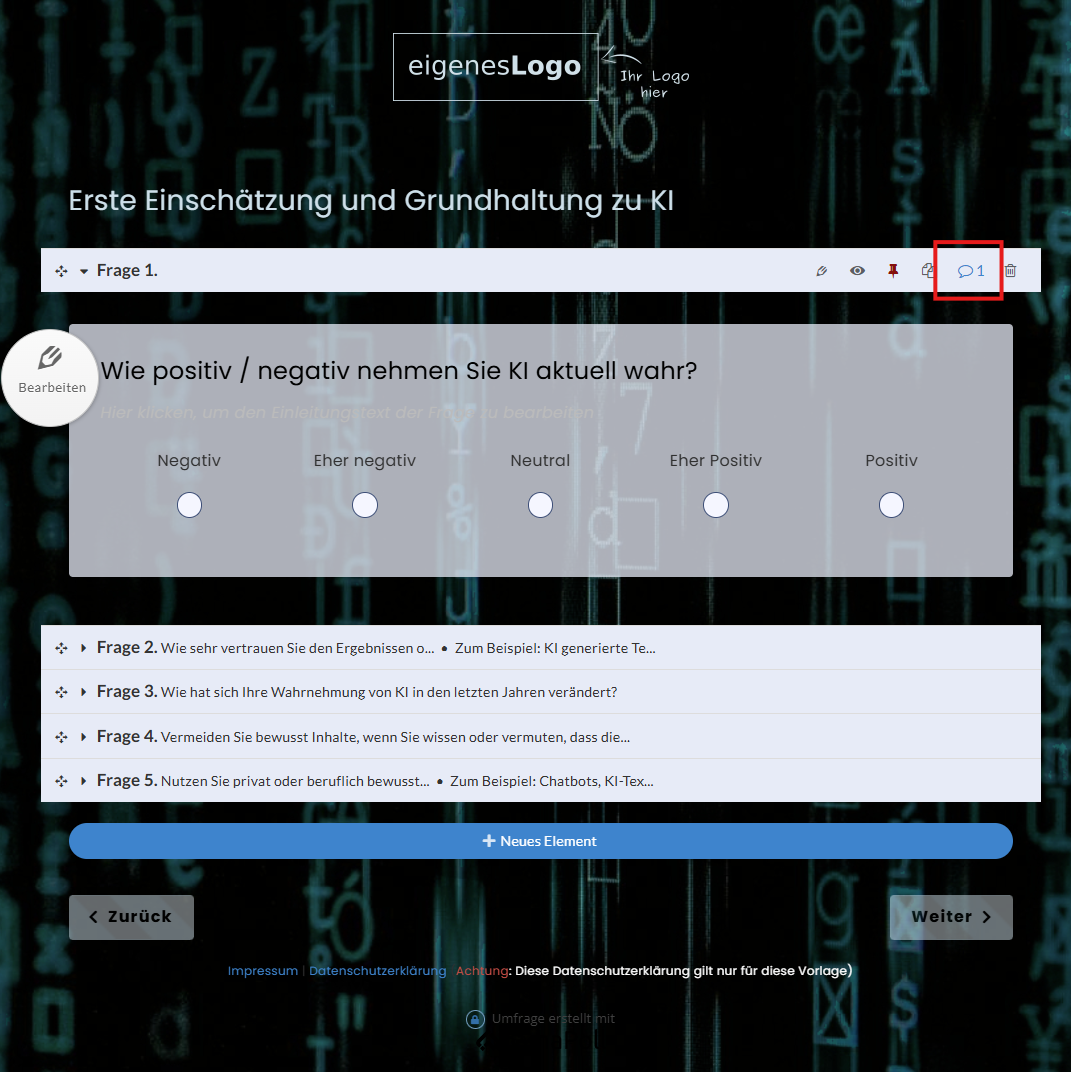
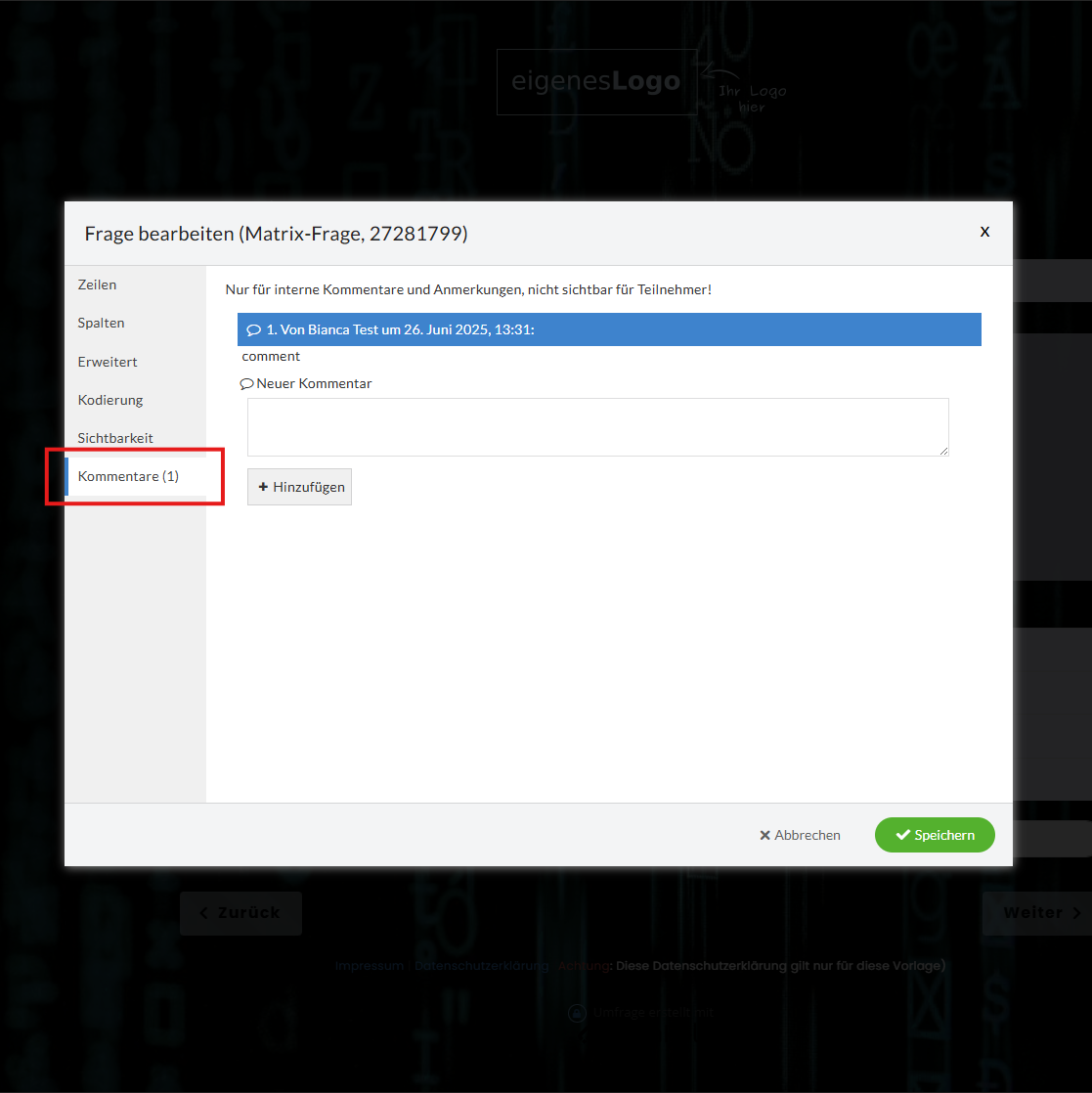
Figure: Commenting feature in the LamaPoll editor
A structured pretest questionnaire is still useful because it gathers additional feedback on the overall impression, length and clarity of the entire questionnaire, providing a comprehensive view. For extensive or complex questionnaires in particular, it helps you identify patterns in the feedback and analyse them systematically. This ensures that you improve not only individual details, but also uncover all potential weaknesses and safeguard the overall quality of your survey.
A clear structure and appealing questionnaire layout can help reduce misunderstandings and drop-outs. On our page about questionnaire design, we show you how to structure your survey in a visually appealing and logical way.
Best practices for a successful survey pretest
A pretest is only as good as its preparation. To generate genuinely useful insights, you need to select the right test participants and take the right approach. Asking specifically for feedback and including different perspectives allows you to identify weaknesses early and improve the survey considerably before it goes live. This section explains what matters and which questions you can include in a pretest questionnaire.
Selecting test participants: who should take part in the pretest?
- The test participants should resemble your eventual target group as closely as possible. This makes them more likely to encounter the same challenges as the people who will later take part in the survey.
- Test participants should never have been involved in creating the survey. Familiarity with the content can quickly create blind spots that prevent them from encountering the same problems as the actual target group when answering the questions.
- It may be useful for test participants to use different devices during the survey pretest. Surveys containing images and videos in particular should be tested on different screen sizes and devices.
All surveys created with LamaPoll are fully responsive. This means they automatically adapt to the screen size of smartphones, tablets and desktop computers. Participants can therefore take part conveniently on any device, helping you avoid drop-outs caused by a confusing display.
Ask the right questions in your pretest
Use open-ended questions: Include open-ended questions in the pretest to give test participants space to describe their personal impressions. This enables you to assess the general impression made by the survey, even when participants do not identify specific points of criticism.
Examples:
- What was your overall impression of the survey?
- Were there any points at which you were unsure how to answer?
- Did the order of the questions make sense to you, or did anything seem confusing?
Ask about the clarity of the wording: Targeted follow-up questions about particular questions and wording can help you determine whether anything is unclear or ambiguous. This is especially important for complex sentences and technical terms.
Examples:
- Were there any terms or phrases that you did not understand immediately?
- Which phrases were unclear or ambiguous?
- Were there any questions that you found unclear or open to more than one interpretation?
Ask how the questions come across: Questions may unintentionally be perceived as too personal, judgemental or uncomfortable. Brief follow-up questions about particular questions or the questionnaire as a whole can reveal such issues, allowing you to adjust the wording where necessary. This is especially relevant if a questionnaire covers sensitive topics or needs to appear particularly neutral.
Examples:
- Were there any questions that felt uncomfortable, too personal or too direct?
- Did you feel that any question was trying to influence you or steer you towards a particular answer?
- Were there any questions that made you hesitate to answer honestly? If so, why?
Make it easy to voice criticism: Test participants may be reluctant to criticise a survey, particularly if it appears highly complex or “official”. Make your follow-up questions easy to understand and answer, avoiding technical language and complicated wording.
“Was there anything that confused you?” rather than “Please assess the coherence of the question wording.”
Examples:
- Did you notice anything while completing the survey, whether positive or negative?
- What would you change about the survey?
- Did you find anything confusing, unnecessary or out of place?
The question type plays an important role in how clear your questions are and how participants perceive them. Explore the question types available in LamaPoll to make your survey even clearer and more effective.
Avoid common pretest mistakes
What types of pretest are available and when are they useful?
A pretest can be conducted in a variety of ways. The appropriate approach depends on the scope of the survey and how robust the results need to be. Options range from internal trials with colleagues and external tests with people similar to the target group to professionally supervised pretests, for example in academic research or major projects. For both internal and external tests, we recommend using a structured pretest questionnaire to gather feedback in a targeted and systematic way. Below, we introduce the different options and explain when each method is appropriate.
Internal pretest:
You can conduct an internal pretest with colleagues who were not involved in creating the survey. This is particularly useful for obtaining rapid feedback on the technical implementation and basic logic. An internal trial also provides a useful first impression of how easy the questionnaire is to understand.
External pretest:
An external pretest should involve people who resemble the actual target group as closely as possible. This allows you to test how the survey is received under realistic conditions. This form of pretest is particularly useful for complex or sensitive questionnaires.
Professional pretesting:
Professional pretests are conducted by specialist service providers, often with academic support. This type of pretest is used when the survey forms part of a research project in which robust results are particularly important. Methodical pretesting can also improve the quality of very extensive surveys.
Academic pretesting primarily uses the following methods:
- Qualitative pretesting: This approach examines how participants understand the questions. With the think-aloud technique or individual interviews, the aim is to discover what participants think when reading the questions and whether their interpretation matches the intended meaning.
- Quantitative pretesting: A quantitative pretest uses a larger target group to assess whether the survey works statistically. It provides insights into response distributions, completion times and unusual patterns. It reveals whether the scales are structured appropriately, whether questions are being skipped or whether systematic problems occur during the survey. This method is particularly useful if statistical analysis is planned later.
Conclusion: why a pretest is always worthwhile
A pretest should not be regarded as extra work, but as an important safeguard for the quality of your survey. It helps prevent drop-outs, identify misunderstandings at an early stage and protect the validity and reliability of the results. Thoroughly testing a survey can save you considerable frustration, unnecessary additional analysis work and costly decisions based on flawed data.
A pretest is therefore much more than a final check. It ensures that your questions are understood as intended and that no technical or logical obstacles have been overlooked. This creates the foundation for valid, reliable results that you can genuinely depend on, whether for internal decisions, strategic projects or academic studies.
Pretest questionnaire template
To help you conduct your pretest quickly and easily, we have created a ready-to-use pretest questionnaire template. It already contains important questions for collecting structured feedback on the survey’s overall impression, clarity, technical details and potential weaknesses. Simply add the template to your account, customise it if necessary and start your pretest.
What is LamaPoll?
LamaPoll is a survey tool for creating online questionnaires. Our survey tool lets you create, run and analyse online questionnaires quickly and easily. Create your questionnaire in just a few steps, customise it for your organisation and conveniently invite customers or employees by email. An online questionnaire enables you to gather insights quickly and easily to improve customer or employee satisfaction. You can register for the LamaPoll survey tool free of charge and immediately create and run online surveys with up to 50 participants. If you need more responses for your online questionnaire, simply choose one of our plans: billed monthly, cancel any month. You can also choose from our online questionnaire templates and examples.