
Creating and conducting professional online surveys can be simple, efficient and GDPR-compliant, provided you use the right tool. Modern survey tools allow you to collect valuable feedback from customers, employees and other relevant target groups quickly, securely and in compliance with data protection requirements. This gives survey creators a sound basis for decisions about business strategy, product development or marketing activities. You do not need any programming skills to create an online survey: an intuitive survey tool such as LamaPoll guides you through the entire process. From designing the questionnaire and inviting participants to analysing the results, all the necessary functions are available. Benefit from our independently certified software, a wide range of question types and meaningful analysis options. The following sections provide detailed information on how to create online surveys.
Table of Contents
A simple and secure tool for creating online surveys
Looking for a simple, efficient and GDPR-compliant way to create online surveys? LamaPoll gives you exactly that. Instead of a complicated interface, LamaPoll provides intuitive, self-explanatory survey software that requires no installation. You also need no programming skills, so you can get started straight away. Whether you want to create a highly individual survey or conduct an academic research project, LamaPoll covers a wide range of use cases with ease.
Benefits of creating online surveys with LamaPoll:
- Very easy to use, with no installation or programming skills required
- Your own corporate design for individual questionnaires
- Live results presented graphically
- Numerous free questionnaire templates
- Security and 100 per cent data protection made in Germany
- First-class support by email and phone
Creating online surveys: First steps
The quickest way to familiarise yourself with the LamaPoll survey tool is simply to get started. Create your first online questionnaire and explore the features. To help you find your way around, we recommend watching the video tutorial below as you go. It shows you step by step how to create a survey, set up an introduction page and add your first questions.
Why create surveys online?
Online surveys use questionnaires that respondents can complete directly in their browser. They look much like a website, have their own URL and can be accessed from anywhere, including smartphones and tablets. You can include not only text, but also images and videos. There is no need to compromise on appearance either: you can design your survey entirely in your preferred look or corporate design. In addition to these customisation options, you can tailor each online questionnaire to specific participants where required. Here are a few examples of what you can do with the LamaPoll survey tool:
- Engage participants by creating an online quiz or a personality test
- Optimise your internal processes by asking employees for suggestions for improvement
- Ask your customers directly why they are dissatisfied or what impressed them
- Create individual presentations and show each participant personalised content and questions
- You can even map entire processes, assess them and investigate them
These are, of course, just a few of the ways you can use LamaPoll. Want to embed a survey in your newsletter or on your website? Or automatically send customers a survey after a support request? From workshop evaluations and IQ tests to valuable employee surveys, LamaPoll provides the right platform. You can find more online survey examples here.
Advantages and disadvantages of online surveys
No IT expertise? No problem. With LamaPoll, you need neither your own webspace nor programming skills or a designer for your layout. The software is easy to use, allowing you to create professional, dynamic online surveys that can be adapted at any time. You can also reliably prevent multiple participation in online surveys. This effectively prevents duplicate responses from distorting your analysis. Anonymity and data protection are key considerations whenever surveys are distributed and completed online.
With LamaPoll, you do not have to worry about your data being passed on to third parties. Our servers are located exclusively in Germany. We provide the survey tool and store the data for you, but you retain control of your data at all times: you can edit, delete, export or deactivate it whenever you wish. Find out more about our ISO/IEC 27001 certification, our TISAX® certification and all the measures we take to ensure the security and protection of your data.
One of the biggest advantages of online surveys of any kind is the reduction in paper use. This is not only about saving the raw material itself, but also the considerable effort involved. The logistics alone of regularly surveying customers, suppliers or employees on paper can be substantial, and postage adds further costs. Paper surveys certainly have their place, but if you want to work efficiently and cost-effectively, online surveys are an excellent option.
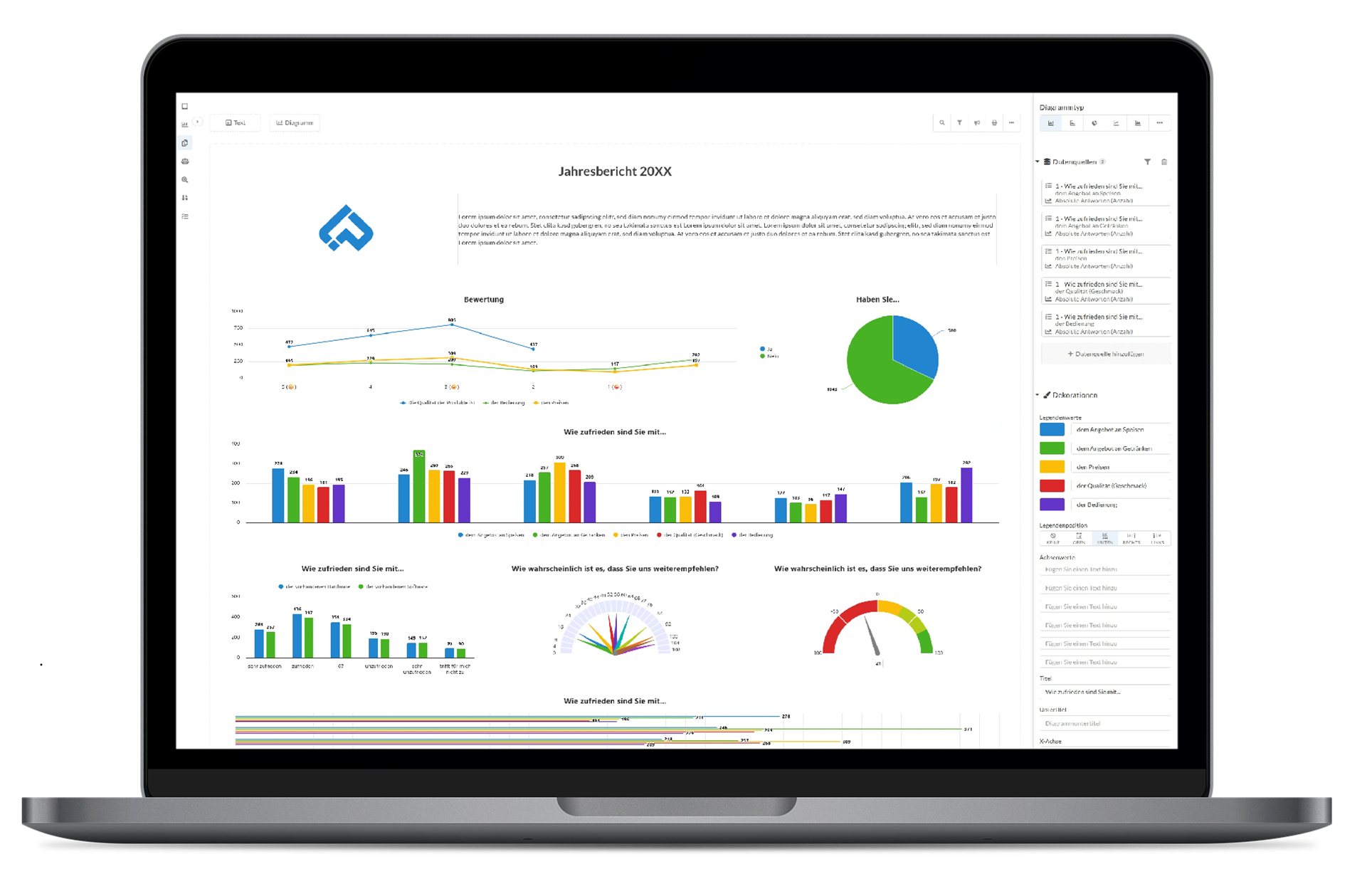
As well as reducing costs and resource use, online surveys give you much greater flexibility in the scale and speed of your projects. Surveys created with LamaPoll can be made available to participants anywhere in the world with a click. For example, you can run weekly surveys of employees across a global organisation and have graphically presented live results available immediately.
 |
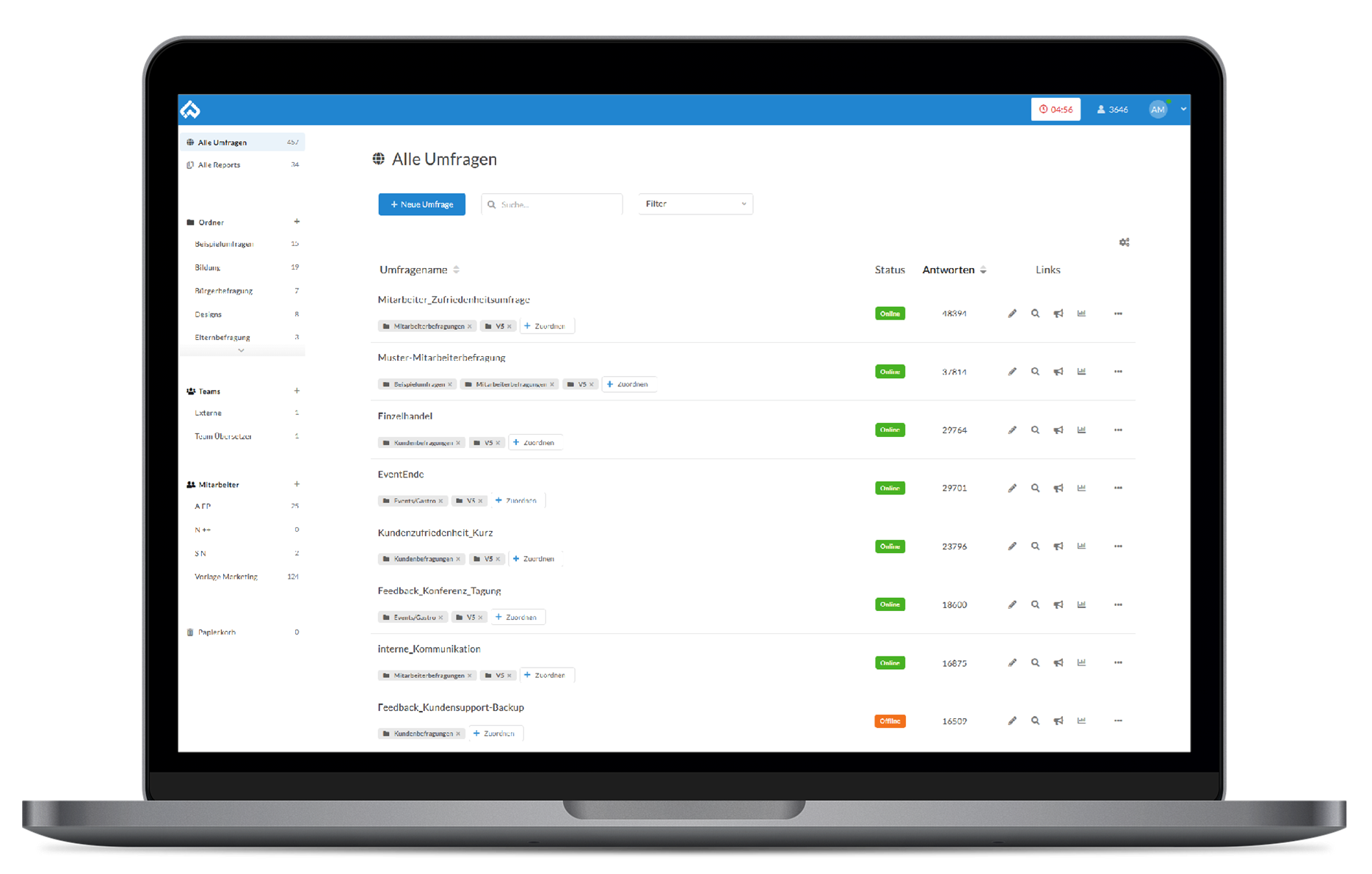 |
Fig. 1 - Live results as soon as your survey starts: View graphically presented data in real time, ready for analysis, presentation and action.
Can you conduct a representative survey online? Yes. Online surveys are sometimes assumed to lack representativeness, but this concern does not apply across the board. In 2023, 83 per cent of Germany's population used the internet to send and receive emails (source: Statista), so online access gives you broad reach among potential participants. Looking at internet use by gender also shows very little difference between men and women. In Germany in 2023, 33.6 million male and 33.3 million female users were online (source: Statista). The difference between the genders is therefore marginal. You can further reduce the risk of an unsuitable sample by using targeted screening questions to narrow down your target group and disqualify participants who do not meet the relevant criteria.
The advantages of an online survey at a glance:
- Save time and money compared with paper or telephone surveys
- Real-time data available immediately
- Create individual, dynamic surveys without design or IT expertise
- Anonymity and data protection
- Multiple participation in online surveys can be prevented
- Representative samples can be achieved with appropriate survey design
At LamaPoll, we believe that online surveys do not inherently have disadvantages. What matters is choosing the right survey tool, preparing carefully and having a clear objective for your survey. There are, of course, still manageable risks. We have already discussed two potential risks, multiple participation and representativeness, and shown how they can be addressed in the context of online surveys. Find out more about the risks of online surveys.
Tips and tricks for your online survey
Online surveys can be used for such a wide range of purposes that the most useful tips depend on the type of survey. In customer surveys, the focus is often on design; in employee surveys, anonymity and data protection are particularly important; and in entertaining applications such as quizzes or IQ tests, survey entertainment can play a greater role.
There are, however, several tips that apply to almost any online survey:
- Compatibility: If you want to reach a large number of people and cannot assess how comfortable your target audience is with technology, it is advisable to keep complex elements in your online survey to a minimum. These include drag-and-drop elements and videos. This helps ensure that your content can be displayed correctly in all browsers, including older versions.
- Mobile use: If you are planning a mobile survey for smartphones and tablets, optimise the questionnaire for mobile devices while creating it in the survey tool. You can switch to the mobile view in the live preview at any time to check that your content appears as intended.
- Less is more: Ask only the questions that matter. Decide in advance what your survey needs to focus on and concentrate on the relevant content.
- Demographic and difficult questions: Some recommend putting demographic questions at the end, while others advise asking them at the beginning. Both approaches have advantages and disadvantages. At the start of the questionnaire, these questions are less likely to be overlooked, but they may deter some respondents. At the end, respondents may be more willing to answer them because they already understand the context, although some may leave before reaching that point. The same applies to difficult questions: placed at the beginning, they create an early hurdle. If respondents overcome it, they may be less likely to abandon the survey. At the end, respondents may also be reluctant to abandon a questionnaire they have nearly completed. In practice, however, difficult questions can cause frustration and drop-outs wherever they appear.
- Common sense: Create your questionnaire, leave it for a while and then review it with fresh eyes. Do the questions follow a logical sequence? Have you covered everything you need? Most importantly, is the survey easy to complete? Are the questions clear, or is there room for interpretation? Do you really need this many questions? Take enough time and keep your participants in mind throughout.
How to find the right tool for your online survey
Check the legal notice of the survey tool provider you are considering. If there is none, this may indicate that the provider is not meeting applicable legal requirements. If a legal notice is available, look closely at where the provider is based. Some providers advertise “100 per cent data protection” prominently while stating less visibly in their terms and conditions that the company is based abroad. This can affect which data protection rules and legal frameworks apply.
The United States does not have a single comprehensive federal data protection law equivalent to the GDPR. You should also look carefully at providers based in Asian countries or other countries outside the EU. Even if the provider's registered office appears trustworthy, ask exactly where your data is stored. For cost reasons, many providers use public clouds, where your data is stored on infrastructure shared with data belonging to many other companies and individuals. At LamaPoll, we use only our own dedicated servers, and no other customers have access to your data.
Keep an eye on price. The cost of survey tools varies considerably between providers. Check in advance what you are paying for, which features you actually need and which option makes sense for you. You can find an overview of our plans and pricing.
Do not underestimate support. You often only appreciate good, personal support when you need it. When that happens, having competent people you can actually reach is essential. Chatbots and contact forms alone can cause more frustration than assistance in time-critical situations.
Why trust LamaPoll?
- LamaPoll stores your data exclusively in Germany on its own dedicated servers, not in a public cloud.
- LamaPoll can be reached by phone and provides friendly, German-speaking support.
- LamaPoll also offers transparent pricing. See for yourself and try the survey tool free of charge with our Free plan. You can find all plans, prices and features in our plans & pricing overview.