Digital platforms, tools and media open up new ways for young people to take part online. They provide a framework for active, self-directed participation in political, social and community processes and give young people opportunities to have their say. Digital services are essential for reaching young people in an age-appropriate way, on equal terms and within the context of their everyday lives. Online formats are not automatically a replacement for traditional forms of participation such as public meetings, forms or notices. Instead, they are a valuable addition for associations, local authorities, educational institutions and others seeking to reach young people and give them a platform to contribute on issues such as the environment, road safety, leisure activities, education or urban development.
Table of Contents
Digital participation: why give young people a platform?
Young people have ideas, opinions and their own views of the world, and they need opportunities to take part in issues that affect them. Whether the topic is climate action, education, leisure or transport, young people are often overlooked or underrepresented in political processes. Yet interested young people in particular can contribute important and forward-looking ideas to society.
They also have the right to be heard. This right is enshrined in Article 12 of the UN Convention on the Rights of the Child, which recognises children's right to form and express their views freely. Section 8 of Book VIII of the German Social Code (SGB VIII) also requires children and young people to be involved in decisions made by public youth welfare services in line with their age and maturity. In addition, there are numerous participation rights at federal-state, local-authority and municipal level, including children's and youth parliaments.
A concise overview of the legal framework is available here: Legal framework for the participation of children and young people (German).
The way in which participation rights for children and young people are regulated varies between Germany's federal states. In Berlin, the AG KJHG governs the implementation of child and youth welfare legislation and, among other things, the promotion of participation and democratic education for young people. Since 1 January 2022, the current version has been known as the “Youth Welfare, Family and Youth Promotion Act”. Provisions promoting participation and democratic education for young people had already entered into force under the Youth Promotion and Participation Act on 1 January 2020.
Giving young people opportunities to have their say, help shape decisions and be heard is not merely optional; it is a legal responsibility. This makes it all the more important to create digital participation formats that provide a contemporary way to get involved.
Taking a strategic approach to online youth participation
Digital youth participation formats reach young people within their everyday lives, provide quick, inclusive and accessible routes to participation and reduce barriers to getting involved. This does not mean that in-person formats such as meetings, workshops or forums have become obsolete. Rather, the aim is to create additional, straightforward channels for communication and participation.
Digital participation formats do more than broaden access. They also make youth participation more visible, allow it to be evaluated systematically and enable results to be used strategically for projects, planning and funding applications.
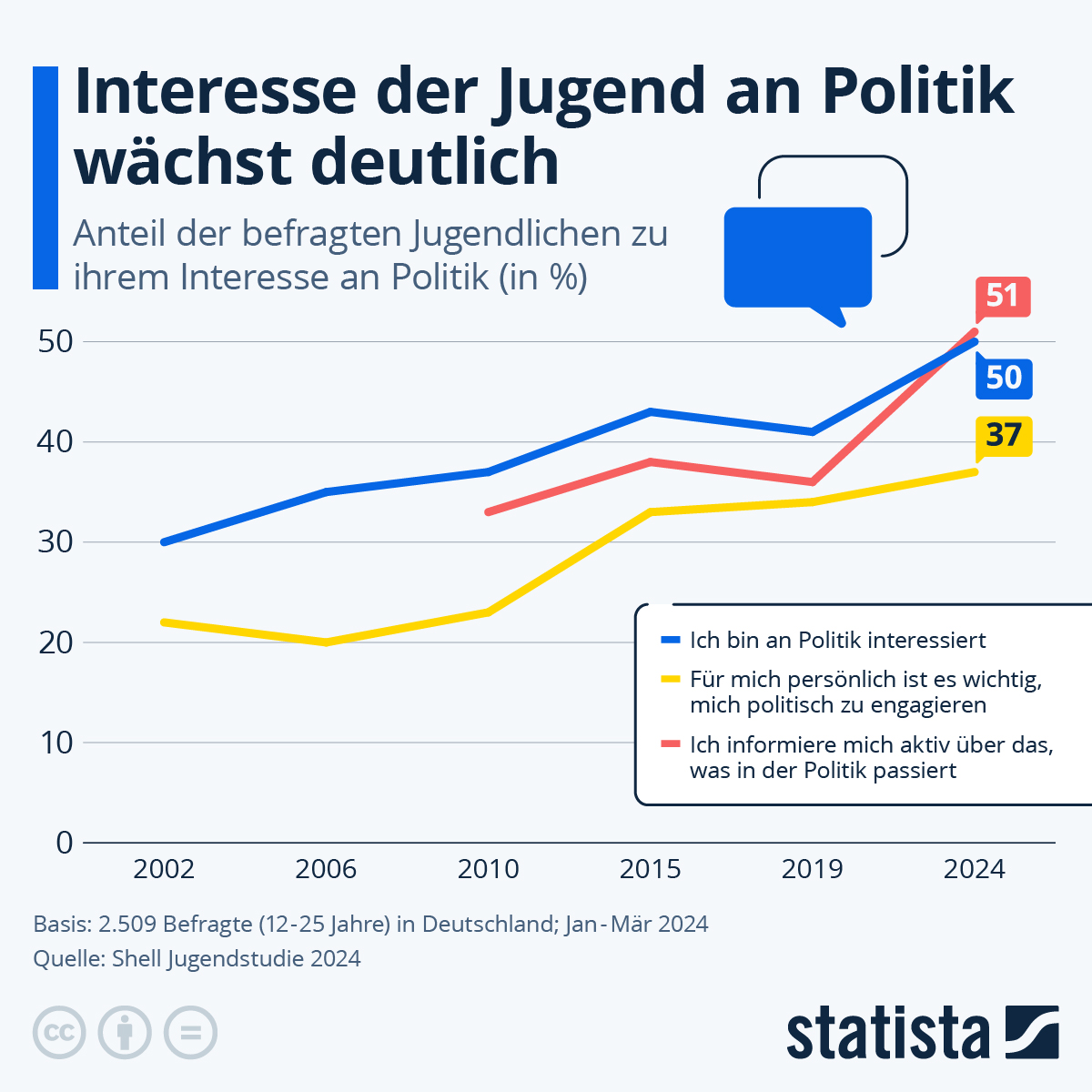
Figure: Youth study on interest in politics in Germany (source: Statista)
The Shell Youth Study conducted in 2024, shown above, indicates a high level of political interest among young people. Many young people regularly follow social developments and engage with important questions about the future. Alongside traditional media, social media channels in particular play an important role in learning, exchange, engagement and sharing information.
For local authorities, associations, organisations and other bodies, this represents significant potential for participation. Realising that potential requires suitable opportunities and engaging formats that capture different views in a way that suits the target group and presents them transparently.
All you need is an email address and a password to get started.
What options are available for online youth participation?
Digital participation formats give young people flexible ways to contribute their opinions, ideas, priorities and views in a structured way. They can be adapted to different age groups, make participation projects easier to implement and provide robust data to support informed decisions. At the same time, they give young people a meaningful opportunity to experience democracy and take an active part in it.
There are various digital formats available for youth participation. Depending on the project and its objectives, these can be short-term or long-term and can also be combined. As a general rule, the earlier you involve young people in a project, the better. This allows you to make full use of their input and incorporate it into further planning.
Below are five online participation formats and tools you can use:
- Online surveys and voting: Professional online surveys using tools such as LamaPoll allow opinions, sentiment, feedback, criticism and priorities to be collected in a structured and targeted way. This makes it easier to identify trends, needs and areas for action and then analyse the results.
- Digital workshops and discussions: Ideas can be collected, discussed and developed further in real time. Formats of this kind, for example using tools such as Mentimeter or Miro, support interactive participation and give young people opportunities to contribute and influence the discussion.
- Gamified formats: Playful elements, challenges, learning activities and small competitions can increase motivation to participate, strengthen engagement and encourage younger age groups in particular to get involved. QuizAcademy is one example of a suitable tool.
- Interactive exchange via chat or messenger: Low-threshold communication, for example via Threema, enables quick, simple and accessible feedback as well as live chats or moderated discussions.
- Podcasts: Projects such as the youth participation podcast “Gute Frage, Nächste Frage!” by Servicestelle Jugendbeteiligung and “Talk & Tools - Der Jugendbeteiligungspodcast” by Landesjugendring Mecklenburg-Vorpommern show how digital formats can be used to inform young people and encourage participation. The podcasts regularly present different participation formats, provide information and highlight ways to share experiences and perspectives.
Not every format suits every project. Consider your objectives and available budget at an early stage. Online surveys, voting and polls, for example, can usually be implemented more quickly and cost-effectively than digital workshops. Workshops require considerably more resources, but can also provide deeper insights.
What should you consider when planning a digital youth participation project?
Online youth participation requires structured preparation and sufficient time. Time is needed not only for planning but above all for implementation. A first step is to prepare and involve young people appropriately and to build trust. This is generally easier with more extensive formats such as discussions, podcasts or workshops than with online surveys.
At its core, however, the aim is to show your target group what the project involves and what results or decisions may follow from it.
You should also bear in mind that young people themselves need time for participation and engagement. To make a project workable alongside school, training, part-time jobs and similar commitments, it is usually best to allow a generous timeframe. Consider security and data protection from the outset.
Under Article 8 of the EU General Data Protection Regulation (GDPR), special rules apply to information society services offered directly to children: where processing is based on consent, that consent is valid from the age of 16. For younger children, consent or authorisation must be given by the holder of parental responsibility. Depending on the participation format, consent may therefore be required.
Accessibility is another important consideration. Digital formats often have the advantage of being location-independent and flexible in terms of timing. This can reduce barriers to participation and make it possible to include people who cannot attend in person due to disability, mobility, distance or caring responsibilities.
Digital participation formats also provide further ways to make youth participation more accessible:
- Accessible design: Digital formats offer opportunities for accessible or low-barrier implementation. In addition to simple, clear language, multilingual options can be provided where appropriate. Good readability, clear navigation and mobile usability are equally important. Provide transcripts for audio formats, subtitles for videos and ensure compatibility with screen readers.
- Different ways to participate: Online formats enable several forms of participation. If, for example, you share an online survey through your social media account, young people can take part in the survey. They may also comment on the post, give feedback or share it themselves.
- Lower barriers and anonymity: Digital spaces provide alternative ways for people to contribute. Not everyone is comfortable discussing feedback or opinions publicly, and some people may hold back for that reason. Online formats can provide a lower-threshold route into participation and help foster longer-term interest in engagement.
- Participating on their own terms: Some digital participation formats allow people to take part asynchronously. Young people can contribute at a time that suits them. Organisers benefit too: for example, they can respond to initial feedback while a survey is still running. Social media comments can also be collected over a longer period, used as a basis for further discussion and ultimately evaluated in a structured way.
Involving young people in decisions: examples, objectives and questionnaires
Digital youth participation is useful when specific projects and decisions need to be assessed, discussed, evaluated and developed from the perspective of young people. Local authorities and organisations can use formats such as online surveys, voting or petitions to gather feedback from young people on political issues and support participation.
Involving younger generations in political decisions can be particularly appropriate when they are directly or indirectly affected by a planned measure. Examples include surveys on new military service legislation, possible social media restrictions or changes to the minimum voting age. Youth surveys can also be used in areas such as climate action, education, digitalisation and mobility to gather opinions and align measures more closely with actual needs. The participatory process is comparable to a general citizen survey, but the target group is limited to young people.
The result is a stronger basis for decision-making, grounded directly in the everyday realities of young people rather than developed only in theory, which can help increase acceptance and the long-term viability of subsequent measures.
Digital youth participation is much more than a one-off feedback instrument. Used purposefully, it can support democratic participation and contemporary decision-making and provide an important basis for sustainable, accepted and effective decisions.
Questionnaire templates for youth surveys
When creating youth surveys, you can use our sample questionnaires on youth policy issues and topics as a starting point. The free questionnaire templates can be copied into your own LamaPoll account with a single click and adapted as required.
Support youth participation with online surveys using LamaPoll
LamaPoll is an ideal tool for implementing online youth participation securely, efficiently and flexibly through professional youth surveys. You can use a wide range of question types and customise surveys with logos, colours, CSS, fonts and images. All LamaPoll surveys are responsive, so participants can access them on any device. You can also find out more about our options for accessibility.
Reduce barriers to participation further by creating a multilingual survey using our translation feature. This also allows you to create surveys in plain language. You can find further guidance on the LamaPoll blog.
By the way: If you want to use LamaPoll for a school project, our LamaPoll schools programme may be relevant. We provide schools with a permanently free school plan. This can support evaluation, school development processes and, of course, involving pupils directly.
Collect direct feedback on teaching, events, school climate or school services, or run a vote or online election. LamaPoll also offers a dedicated free programme for schools.
Alongside schools, LamaPoll also supports pupils and students with free academic plans. These can be used to support independently organised initiatives, projects and campaigns with feedback surveys, a needs analysis or targeted online voting. Find out more about plans for pupils and students here: Students.
We also provide further practical and field-tested questionnaire templates for education. Use the button below to view all available templates.

We have been using LamaPoll for many years, both for small, quick surveys and for more comprehensive surveys with many questions, and we are extremely satisfied. Creating surveys is simple and intuitive. We also manage more complex question formats, including dependencies and similar logic, very well. In addition, we can brand our surveys with our logo and matching colours. The company and server location in Germany, as well as the option of a product donation, were also decisive factors in choosing LamaPoll.