OKR stands for “Objectives and Key Results” and is a proven management method that enables organisations to set priority goals and measure progress transparently. The OKR method is based on collaboration: everyone works together within the framework towards overarching goals. A defining feature of OKR is the combination of qualitative objectives with quantifiable success metrics. While traditional goal-setting methods can remain vague or become lost in complex KPI systems, OKR creates a balance between ambitious objectives and measurable results. Objectives and Key Results can also translate abstract organisational goals into concrete actions and provide an objective basis for assessing success. The following sections explain how the method works, when organisations should use OKR and why online surveys are a proven instrument for measuring Objectives and Key Results successfully.
OKR method: definition and examples of OKR sets
OKR is a management method used by organisations to set ambitious goals and make progress measurable through concrete results. The OKR method is based on a two-part system that links an overarching, often strategic goal with the measurable results associated with it. The overarching, usually strategic goal, the Objective, describes what is to be achieved and is generally ambitious. The Key Results are metrics that define how success will be measured.
- Objectives are qualitative descriptions of what is to be achieved. They should be clear, time-bound and ambitious but achievable. An Objective might be “Deliver the best customer experience in our industry” or “Become the market leader in the German e-commerce segment”.
- Key Results are specific, measurable and time-bound metrics that quantify progress towards the Objective. Typically, two to four Key Results are defined for each Objective. These can be assessed in binary terms: achieved or not achieved. For the Objective “best customer experience”, Key Results might include increasing the Net Promoter Score from 30 to 50, reducing complaints by 40% or improving the customer retention rate from 60% to 75%.
Short definition of OKR: OKR is a method for setting one or more goals, or Objectives, and measuring progress using several concrete results, or Key Results. An Objective describes what is to be achieved. Key Results are the metrics used to assess whether the goal has been achieved.
How does an OKR cycle work?
The OKR process usually follows several consecutive, structured cycles, each typically lasting three months. This rhythm allows organisations to respond to change with agility while keeping long-term strategic goals in view. A single cycle is generally divided into several phases.
The four-phase structure used in the following example, planning, implementation, evaluation and review, is common but not the only possible way to organise an OKR cycle. It combines several phase models used in practice and can be adapted as required.
Because OKR does not prescribe a rigid model, cycles may also be shorter or longer. The underlying individual steps, however, should still be followed.
Detailed process of an OKR cycle
1. Planning
At the start of the cycle, Objectives for the coming period are formulated and paired with suitable Key Results. Planning follows a clear sequence: first, the organisation defines its overarching strategic goals. Teams or departments then develop their own OKRs based on these goals so that they contribute to the organisation’s overarching objectives through vertical alignment. Individual goals and tasks for employees are in turn derived from the team OKRs.
A significant proportion of OKRs are not created purely top-down. Teams often propose them upwards and coordinate them with the next level, such as department management, an OKR Master or senior management. Whether, and in what proportion, a reciprocal top-down and bottom-up approach is useful depends on the organisation’s circumstances.
In the next step, teams also coordinate their OKRs with those of other departments at the same level through horizontal alignment. The aim is to identify areas of overlap and avoid conflicting or isolated goals.
Finally, the agreed OKRs are made visible across the organisation so that everyone involved can see the goals of other areas. Regardless of the level at which they are created, all OKRs remain consistently aligned with the organisation’s overarching goals.
2. Implementation
During the cycle, work continues on the defined Key Results. Progress is recorded at shorter intervals, usually weekly or fortnightly, during check-ins. If progress deviates from the plan, possible adjustments to the approach are discussed without changing the underlying goals themselves.
In addition to weekly meetings, short daily stand-ups may be useful for individual teams. Depending on how the OKR process is organised within an organisation, other intervals may also be chosen for interim reviews.
3. Evaluation
At the end of a cycle, the degree of goal achievement is assessed against the Key Results, usually on a scale from 0 to 1.0. Two types of OKR are commonly distinguished: ambitious and committed OKRs.
For deliberately challenging stretch OKRs, achieving around 60% to 70% is already considered a success. Consistently achieving 100% of these ambitious OKRs often indicates that the targets were set too cautiously. Committed OKRs are less common and are set in exceptional cases. Unlike stretch OKRs, committed OKRs are intended to be achieved in full, meaning 100%.
4. Review
After the evaluation, the team holds a retrospective to reflect on the completed cycle. Two perspectives can be distinguished: first, which goals were achieved and what can be learned for future goal-setting; second, how well the collaboration and process worked, including where improvements are needed. Both sets of findings feed into planning for the next cycle, closing the loop.
OKR cycle at a glance: short version
A typical three-month OKR cycle usually includes the following steps:
Planning
- Setting goals and defining Objectives and Key Results
- Alignment and linking
- Communication and transparency
Implementation
- Implementation and ongoing tracking
- Interim review through check-ins
Evaluation
- Final assessment and scoring
- Review of success
Review
- Retrospective
- Transition to the next cycle
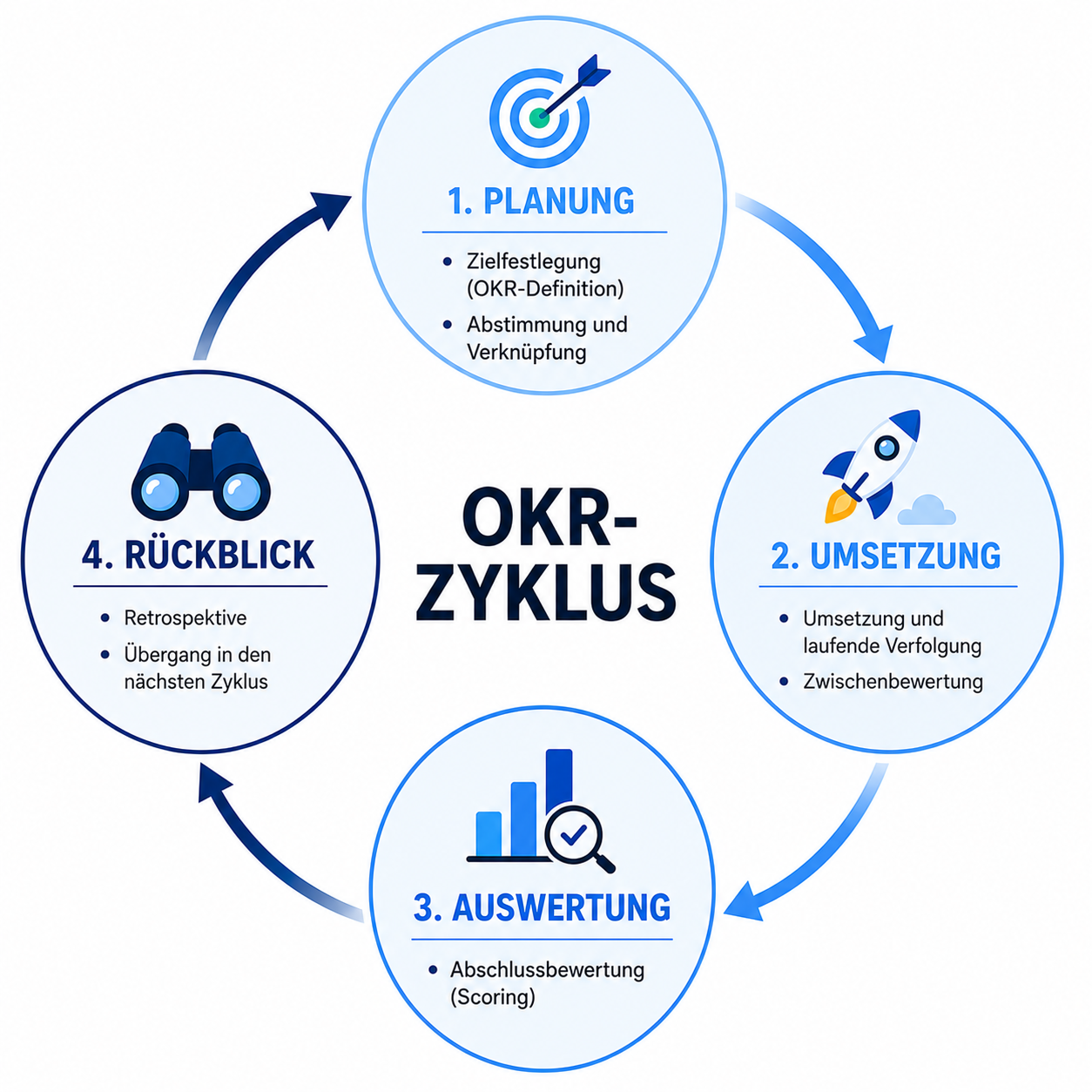 Fig.: Diagram of the relevant phases of an OKR cycle.
Why are Objectives and Key Results effective?
The effectiveness of OKR is based on several principles that distinguish the framework from conventional goal-setting methods. These principles are intended to ensure that OKR is not simply another method for reaching goals but changes how organisations approach them. Focus comes first: organisations deliberately concentrate on no more than three to five Objectives per period in order to set clear priorities and concentrate resources. Alignment ensures that all levels of the organisation work towards shared goals, while transparency means that OKRs are visible to all employees.
Setting ambitious goals is particularly important. In the context of OKRs, achieving 60% of a deliberately ambitious target can already count as success, encouraging organisations to pursue challenging goals. The regular cycle of review and adjustment, usually quarterly, allows organisations to respond to change with agility and learn continuously.
Core principles of the OKR framework:
- Focus on clearly defined goals
- Ambitious goal-setting
- Shared alignment
- Transparent working practices
- Cyclical review of progress
When should organisations use OKR?
OKRs are particularly suitable for organisations operating in dynamic markets that need to respond quickly to change. Organisations seeking growth, greater innovation or better collaboration between teams can benefit especially from the method. OKR can be implemented by both start-ups and established corporations, although smaller organisations often see results more quickly because their coordination processes are less complex. The OKR method is particularly useful where qualitative goals such as customer satisfaction, employee engagement or brand awareness and perception play an important role, because these can be made measurable through suitable Key Results.
Not every Key Result can be derived from existing data such as revenue figures or click-through rates. Many relevant metrics are based on subjective assessments such as satisfaction, perception or motivation, which can only be collected directly from the people concerned. This is where surveys are useful: they make soft, subjective factors measurable and provide the data needed to support qualitative Objectives with concrete, traceable Key Results. The following sections provide practical examples of how surveys can be used within OKR.
Using surveys within OKR: how it works
Surveys are a proven instrument for implementing OKR successfully because they provide the data needed for realistic goal-setting and precise monitoring. Particularly for qualitative goals that cannot be derived automatically from business systems such as CRM or ERP, professional surveys make objective quantification possible. For example, when customer satisfaction, employee engagement or brand perception are examined within OKR, online surveys are among the most reliable data collection methods. They can be used during planning, throughout implementation and for the final evaluation of the OKR cycle.
- For baseline measurement before an OKR cycle begins, surveys can measure current customer satisfaction, employee engagement and employee satisfaction, or analyse market positioning. These starting values provide the basis for realistic yet ambitious Key Results.
- During implementation, regular short surveys enable precise progress monitoring. Short, focused monthly surveys on specific Key Results can act as an early warning system for emerging problems and help teams make timely adjustments.
- Quarterly detailed analyses provide comprehensive assessments of OKR performance, help investigate the causes of deviations and support preparation for the next OKR cycle. This systematic approach supports continuous improvement and data-based decision-making.
How are different Key Results measured?
Depending on the Objective and subject area, the associated Key Results require different measurement and data collection methods. A customer support team, for example, needs different data from an HR department or a marketing team, even if all three are working within the same OKR cycle. For each Key Result, the appropriate measurement method should therefore be selected with both accuracy and efficiency in mind.
Customer-related Key Results can be measured effectively using established methods such as the Net Promoter Score (NPS) for willingness to recommend, the Customer Satisfaction Score (CSAT) for specific touchpoints or the Customer Effort Score (CES) for assessing the customer experience.
Employee-related Key Results require internal surveys on employee engagement, motivation, employee satisfaction or job satisfaction. 360-degree feedback can also be collected through surveys to assess managers and employees.
Market-related Key Results can be measured, for example, by analysing brand awareness, conducting customer surveys or carrying out market potential analyses. These data help organisations assess their competitive position realistically.
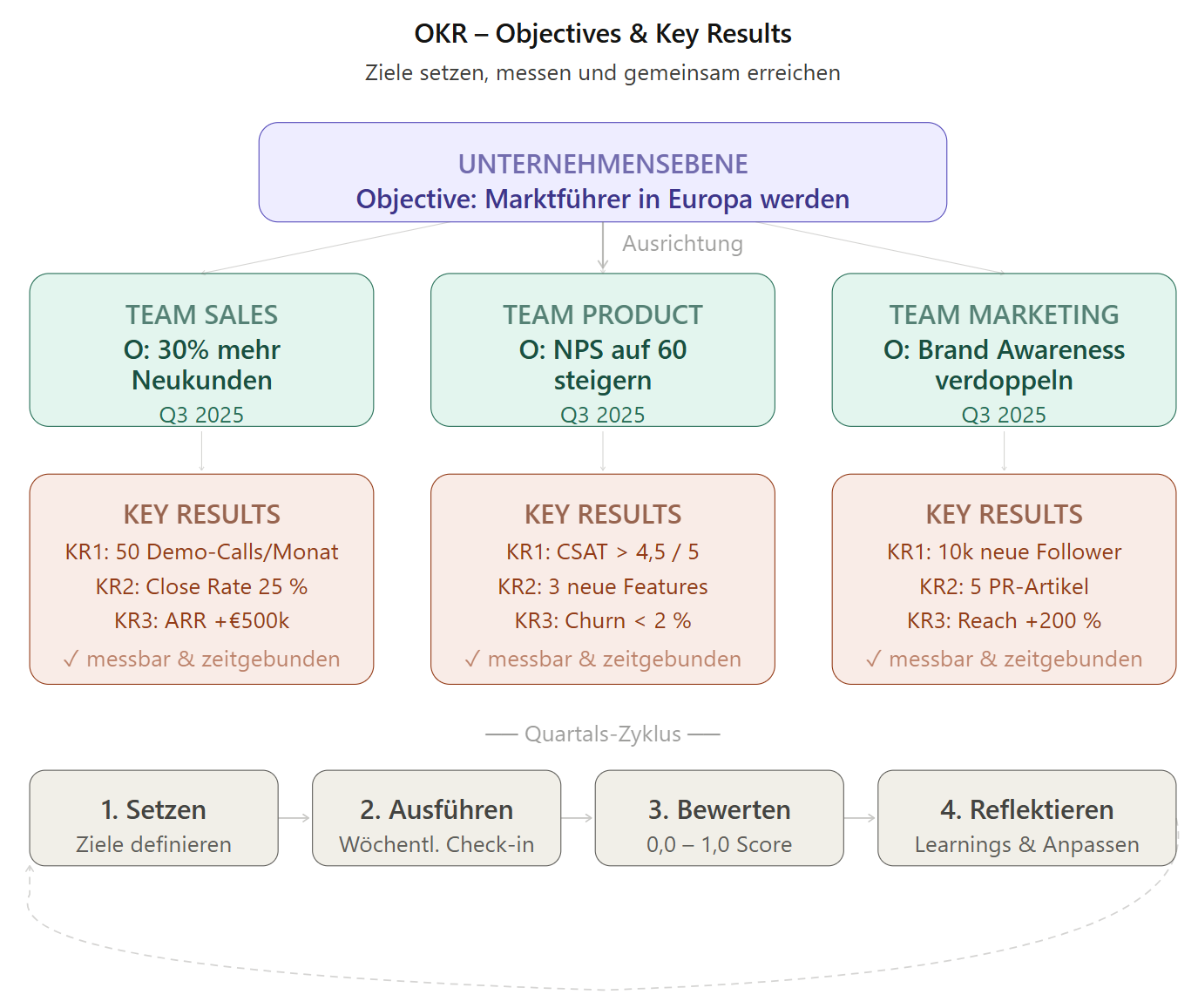 Fig.: Examples of Objectives and Key Results for different teams
Which tools support OKR measurement?
Modern survey tools provide an effective basis for systematic OKR measurement. Surveys can support planning and accompany the entire process. The challenge is to define suitable metrics and carry out both one-off measurements and trend analyses. Regular surveys then enable continuous monitoring, while real-time results allow progress to be reviewed throughout the OKR process.
Professional survey tools can also provide segmentation analyses by team, region or customer segment for more granular insights. In addition, the development of OKRs can be visualised over time using trend analyses and pulse surveys.
When designing questionnaires for OKR, established principles should still be followed: short, focused questionnaires, consistent scales for valid comparisons, a balanced mix of quantitative scores and qualitative insights, and a responsive design can all help improve response rates.
OKR: weaknesses and common pitfalls
Objectives and Key Results (OKR) are a popular framework for goal-oriented management, but they are not without criticism. Since large technology companies popularised the method, many organisations have followed their example. In practice, however, recurring weaknesses and implementation errors can reduce the expected benefits or even produce the opposite effect. OKRs can, for example, become such a strong focus that other important projects are neglected.
The framework itself also has structural weaknesses. One reason is that OKR was originally developed for fast-moving digital business models. Adapting it to other, less agile industries and business models can therefore be difficult. In addition, the regular meetings and coordination inherent in the system can create extra work that is hard to reconcile with day-to-day operations.
Before introducing OKR, organisations should therefore consider the following weaknesses and possible pitfalls and adjust the set-up where necessary:
Conflict between ambition and performance assessment
The OKR method is intended to encourage ambitious goals, with typical target achievement of 60% to 70%. At the same time, many organisations use OKRs as part of performance assessment. This combination can lead teams to set more conservative goals for fear of negative evaluation rather than pursuing the intended level of ambition.
Unrealistic goals as a source of demotivation
Deliberately ambitious goals are intended to encourage high performance, but repeatedly missing them can have the opposite effect. If a Key Result remains far out of reach across several cycles, motivation may fall rather than rise.
Disproportionate time commitment
Formulating, aligning and regularly tracking Objectives and Key Results takes considerable time. Particularly in small and medium-sized organisations, the effort may be disproportionate to the benefit. The actual time required to maintain OKRs depends heavily on implementation. Too many OKRs per team, overly frequent check-ins or excessive documentation can increase the workload substantially.
Weak connection to day-to-day operations
OKRs represent strategic priorities, not day-to-day operational work. In practice, this can create a parallel system: OKRs exist on paper, while actual priorities in daily work are determined by other criteria. The opposite can also occur, with OKRs being prioritised so heavily that other important projects are neglected.
Risk of optimising only for the metric
If Key Results dominate attention too strongly, teams may optimise specifically for the metric without contributing to the organisation’s actual long-term strategy. It is therefore generally advisable to review during the cycle whether individual Key Result metrics still support the overarching strategy.
Difficulty quantifying qualitative goals
Not every strategically relevant goal can be translated meaningfully into measurable Key Results. Topics such as organisational culture, brand perception or long-term customer relationships are often reduced to proxy metrics that only partly reflect the underlying goal.
Risk of micromanagement
Close, often weekly tracking of Key Results can tempt managers to comment on and intervene in even small deviations. Excessive detail or control by managers can be counterproductive: instead of the intended team autonomy, it can create an atmosphere of constant supervision that undermines personal responsibility.
FAQ about the OKR method
Unlike traditional target agreements, OKRs are transparent, ambitious and organised in short cycles, usually quarterly. They are not linked to bonuses and are designed around the team as a whole.
OKRs are usually set quarterly. Annual OKRs may also exist at organisational level to provide a framework for the shorter cycles.
An Objective should ideally have two to five Key Results. Too many Key Results make the framework difficult to manage and reduce focus.
Failing to achieve an OKR in full is not necessarily a failure. For ambitious goals, an achievement level of 60% to 70% can be considered successful. Committed OKRs are an exception and should be achieved in full.
OKRs are developed and owned collaboratively by the team. An OKR coach can support the process and help ensure that the method is applied correctly.
Questionnaire templates for OKR metrics
Many Key Results within OKR are based on metrics collected through surveys. When creating surveys, you can use our free questionnaire templates as a starting point, copy them to your LamaPoll account and adapt them as required. You can find further questionnaire templates for a wide range of customer and employee surveys here: Questionnaire templates.

We have already been able to run several internal and external customer surveys. It was important to us to have an easy-to-learn, uncluttered tool that provides common question types and still produces attractive surveys on all devices. Data security naturally also plays a major role. LamaPoll offers all of this. 5 stars!

With LamaPoll, surveys can be created quickly and easily. The tool offers many options for individual adjustments. The help pages are useful for solving many questions independently. For special requests, competent and easily accessible customer support is available.
What is LamaPoll?
LamaPoll is a survey tool for creating employee surveys and measuring employee satisfaction. You can use it to create, conduct and analyse all types of employee survey. Create your employee survey in just a few steps, apply your organisation’s corporate design and invite employees conveniently by email or via your intranet. You can quickly gain insights that help improve employee satisfaction. You can register for our survey tool free of charge and immediately conduct surveys for up to 50 employees with no obligation. If you need more responses to your online employee survey questionnaire, simply choose one of our monthly plans. You can also use our employee survey questionnaire templates and examples.